
Poultry houses with covered outdoor access: understanding verandas for laying hens
What is a veranda?
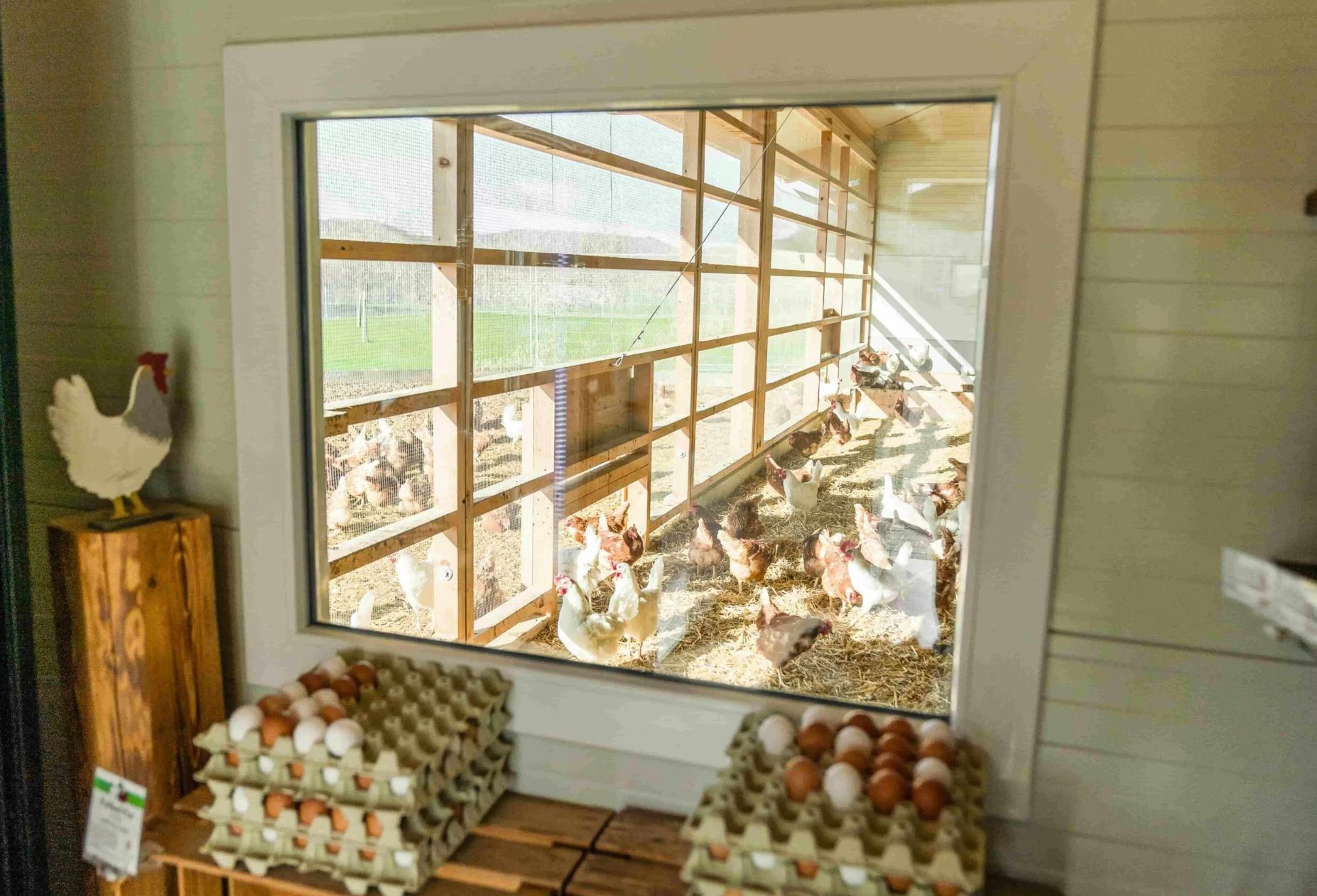
- A veranda or winter garden is an additional roofed structure attached to the exterior of a poultry building, with a floor fully covered in litter. They normally feature wire mesh to prevent or deter wild birds from entering and making contact with the farm’s birds. These structures provide hens with natural light and outdoor conditions. Verandas or winter gardens are becoming increasingly popular in the laying hen industry, and many new layer farms now opt for them when constructing new buildings. They can also be used in broiler production, although their use in broilers remains anecdotal. Optionally, verandas may provide additional access for birds to fully open-air outdoor ranges.
- Verandas offer birds access to and from the main house through a series of internal openings.
- In barn production systems, verandas are simply a complement to the main house and provide natural light and airflow, but no access to a grazing area. They can be constructed as an addition to an existing house (retrofitted) or incorporated into a new build.

Why are verandas so important for hen welfare?
- Installing natural light and verandas in barn systems (poultry houses) that currently have neither natural light nor outdoor conditions can represent a major advance for hen welfare. Verandas offer many welfare benefits for birds, including:
- Providing more natural light (including UVA and UVB wavelengths).
- Direct exposure to natural levels of UVB wavelengths can ensure the production of vitamin D3, which promotes calcium absorption to improve bone strength.
- Providing hens with access to outdoor conditions and a continuous supply of fresh air.
- Offering more space for enrichment and foraging opportunities.
- Maintaining litter quality in the main house.
- Indirect positive impact on plumage condition.
- Reducing stocking density inside the house, thereby giving hens more overall space to move around and improving litter quality within the building.
Where does the evidence that verandas improve hen welfare come from?
- The RSPCA (Royal Society for the Prevention of Cruelty to Animals) is an evidence-based organisation, and any changes to its standards are informed by the most up-to-date research and information available.
- The RSPCA commissioned ADAS to prepare a report on Verandas in poultry farming in 2016. The report covers types of verandas, advantages and disadvantages, and a cost estimate. Although the costs are now outdated, the report highlighted a large number of benefits that verandas could bring to hen welfare.
- The RSPCA also examined systems in Europe that already feature verandas and natural light, and studied the impact this has had on hens. In the majority of cases, hens are less stressed, more active and show less feather damage, and farmers are able to keep hens with intact beaks.
- The European Food Safety Authority (EFSA) recently published a review on “The welfare of laying hens on farm”. After reviewing the research and welfare outcomes, both natural light and verandas were included in the final list of recommendations for urgently improving the welfare of laying hens on farm:
- “Provide a covered veranda for all birds to reduce effective/local stocking density during daytime periods when birds are most active, and to allow birds to choose between temperatures, light conditions and substrate quality. This would reduce the risk of welfare consequences from the inability to perform foraging, exploratory and comfort behaviours. Compared with an open-air outdoor range, the risk of predation stress, gastrointestinal disorders and other infectious diseases in the event of outbreaks in member states will be reduced. In climates where a covered veranda cannot be provided, additional space should be provided for birds” [1].

Use in Europe
- Across Europe, verandas are increasingly being incorporated into newly built laying hen houses.
- Verandas are included as a requirement in the Beter Leven one-, two- and three-star schemes operating in the Netherlands and in the KAT guidelines for laying hen farms operating in Germany. The key aspects required in these verandas are outdoor conditions, natural light and litter provision.
- Producers using verandas report positive outcomes, such as the ability to house birds with intact beaks, improved litter quality and greater activity levels in hens.
Belgium
- Research analysing production systems on Belgian farms in 2015 reported that, of 47 randomly selected laying farms, 28% of barn systems had a covered corridor and 19% had a free-range area that always included a covered corridor [2].
Switzerland
- Similarly to the Belgian farms, researchers observing Swiss farms visited 96 farms and reported that 59.3% of flocks had outdoor access. Furthermore, 48.9% of flocks had access to both a veranda and a free-range area. A veranda without a free-range area was present in 6% of flocks [3].
Examples of some Swiss systems can be seen below:


Review of the scientific literature on veranda use
When not included in the usable area, access to a veranda during the day will significantly reduce stocking density in the main house. There is a clear relationship between higher stocking density and an increased risk of feather pecking [4-6]. Veranda use appeared to increase with rising stocking density on organic farms keeping their laying hens at densities of 6, 9 and 12 birds/m² [7], suggesting the value of a larger litter area.
Hens spend approximately 38% of their daily time budget engaged in foraging behaviours [8], and in the ancestral red junglefowl this can reach 60% [9]. In barn systems, the majority of these behaviours occur in the litter area, along with comfort behaviours such as preening and dust bathing.
It has long been known that litter provision is a key environmental factor enabling birds to perform many natural behaviours and reducing the likelihood of abnormal behaviours developing [10-14]. However, only one third of the environment is covered in litter, and this is also the area where most other enrichment items are provided. The inclusion of verandas in barn and free-range systems provides more areas for the performance of important litter-related behaviours and also increases the space available for a greater variety of enrichment items, such as dust bathing boxes and pecking objects.
The opportunity for choice and environmental complexity have been well studied in laying hens and have positive effects on welfare [15]. Laying hens have strong environmental preferences, which can often be influenced by fear levels [16]. Providing areas where laying hens can choose between different temperatures and light levels is important.

References
- EFSA. Scientific Opinion: Welfare of laying hens on farm. 2022 [cited 2023]. Available: https://efsa.onlinelibrary.wiley.com/doi/epdf/10.2903/j.efsa.2023.7789
- Heerkens JLT, Delezie E, Kempen I, Zoons J, Ampe B, Rodenburg TB, et al. Specific aviary housing characteristics affect plumage condition, mortality and production in laying hens. Poult Sci. 2015;94: 2008-2017.
- Häne M, Huber-Eicher B, Fröhlich E. Survey of laying hen husbandry in Switzerland. Worlds Poult Sci J. 2000;56: 21-31.
- Nicol CJ, Gregory NG, Knowles TG, Parkman ID, Wilkins LJ. Differential effects of increased stocking density, mediated by increased flock size, on feather pecking and aggression in laying hens. Appl Anim Behav Sci. 1999;65: 137-152.
- Huber-Eicher B, Audigé L. Analysis of risk factors for the occurrence of feather pecking in laying hen growers. Br Poult Sci. 1999;40: 599-604.
- Zimmerman PH, Lindberg AC, Pope SJ, Glen E, Bolhuis JE, Nicol CJ. The effect of stocking density, flock size and modified management on laying hen behaviour and welfare in a non-cage system. Appl Anim Behav Sci. 2006;101: 111-124.
- Steenfeldt S, Nielsen BL. Welfare of organic laying hens kept at different indoor stocking densities in a multi-tier aviary system. I: egg laying, and use of veranda and outdoor area. Animal. 2015;9: 1509-1517.
- Bubier NE. The behavioural priorities of laying hens: the effects of two methods of environmental enrichment on time budgets. Behav Processes. 1996;37: 239-249.
- Dawkins MS. Time budgets in red junglefowl as a baseline for the assessment of welfare in domestic fowl. Appl Anim Behav Sci. 1989;24: 77-80.
- Blokhuis HJ, Arkes JG. Some observations on the development of feather-pecking in poultry. Appl Anim Behav Sci. 1984;12: 145-157.
- Gunnarsson S, Keeling LJ, Svedberg J. Effect of rearing factors on the prevalence of floor eggs, cloacal cannibalism and feather pecking in commercial flocks of loose housed laying hens. Br Poult Sci. 1999;40: 12-18.
- Lambton SL, Knowles TG, Yorke C, Nicol CJ. The risk factors affecting the development of gentle and severe feather pecking in loose-housed laying hens. Appl Anim Behav Sci. 2010;123: 32-42.
- Tahamtani FM, Brantsæter M, Nordgreen J, Sandberg E, Hansen TB, Nødtvedt A, et al. Effects of litter provision during early rearing and environmental enrichment during the production phase on feather pecking and feather damage in laying hens. Poult Sci. 2016;95: 2747-2756.
- Schreiter R, Damme K, von Borell E, Vogt I, Klunker M, Freick M. Effects of litter and additional enrichment items on the occurrence of feather pecking in pullets and laying hens: a focused review. Vet Med Sci. 2019;5: 500-507.
- Lay DC Jr, Fulton RM, Hester PY, Karcher DM, Kjaer JB, Mench JA, et al. Hen welfare in different housing systems. Poult Sci. 2011;90: 278-294.
- Nicol CJ, Caplen G, Edgar J, Browne WJ. Associations between welfare indicators and environmental choice in laying hens. Anim Behav. 2009;78: 413-424.