
A field study conducted in the Netherlands has demonstrated that two highly pathogenic avian influenza (HPAI) vaccines effectively protect laying hens from the disease eight weeks after vaccination. This research, carried out by Wageningen Bioveterinary Research (WBVR), part of Wageningen University and Research Centre (WUR), represents a significant advance in combating this disease that severely affects the global poultry industry.
Study Details
The field study, which is ongoing, began in September 2023 and will extend through the third quarter of 2025. A total of 1,800 laying hens housed on two commercial farms were vaccinated. The birds were vaccinated with two different vaccines:
- VECTORMUNE® AI from CEVA Animal Health.
- VAXXITEK® HVT+IBD+H5 from Boehringer Ingelheim.
Eight weeks after vaccination, a group of these hens was transferred to the WBVR Center, where they were exposed to the HPAI H5N1 virus to evaluate vaccine efficacy under controlled conditions.
Methodology
The research focused on several key parameters:
- Virus Transmission: The ability of the virus to transmit between vaccinated and unvaccinated birds was evaluated.
- Survival Rate: Mortality was recorded in both groups following virus exposure.
- Viral Shedding: The amount of virus shed by vaccinated birds was measured in comparison with unvaccinated birds.
- Immune Response: Antibody levels and overall immune response of vaccinated birds were analyzed.
Dr. Evelien Germeraad, veterinary microbiologist at WBVR, explained: “We examined virus transmission following vaccination, as well as survival rate, viral shedding, and immune response. Based on these results, we evaluated vaccine effectiveness”.
Results
The results are proving promising:
- Complete Protection: None of the vaccinated hens became infected following contact with avian influenza virus.
- Undetectable R Value: Because there was no infection in vaccinated birds, the R value (virus reproduction rate) could not be quantified in this group, indicating effective interruption of transmission.
- Effective Control: In the control groups (unvaccinated birds), infection was observed, with an R value of 1.3, demonstrating virus spread in the absence of vaccination.
Implications for the Poultry Sector
These findings are significant for the poultry industry:
- Outbreak Prevention: Mass vaccination could prevent HPAI outbreaks, reducing economic losses and mass culling of birds.
- Animal Welfare Improvement: By preventing disease and associated mortality, bird welfare is improved.
- Food Security: Prevention of HPAI ensures continuity in egg and poultry meat production, contributing to food security.
The Dutch Ministry of Agriculture, Nature and Food Quality (LNV) highlighted the importance of these results: “The fact that the vaccines work in practice is a very important step towards large-scale commercial vaccination of poultry against avian influenza virus”.
Roadmap for Scaling up Avian Influenza Vaccination
The transmission study in production birds will be repeated three more times during the course of the field trial to confirm and expand upon the initial findings. Based on the positive results of this first phase, researchers along with the Dutch Government are preparing the next steps:
- Vaccination Implementation: Programmes are being planned to enable responsible avian influenza vaccination in the Netherlands.
- Monitoring Programme: Establishment of surveillance systems to monitor long-term vaccine efficacy and safety.
- Expanded Pilot Studies: An expanded pilot study involving a larger group of commercial poultry farms is expected to begin in autumn 2024.

Collaboration and Institutional Support
The research is the result of collaboration between several institutions: Wageningen Bioveterinary Research (WBVR), Royal GD (Royal Organisation for Animal Health), Faculty of Veterinary Medicine of Utrecht University, and the Ministry of Agriculture, Nature and Food Quality (LNV)
Background and Previous Studies
In March 2023, WUR research had already demonstrated the efficacy of two vaccines based on turkey herpesvirus (HVT)-H5 under laboratory conditions. Both vaccines proved to be 100% effective in preventing disease, avoiding mortality following infection and virus spread among birds.
Why is it Important to Have an AI Vaccine as Soon as Possible?
Highly pathogenic avian influenza represents a significant threat to the global poultry industry, with considerable economic and health impacts. The demonstrated efficacy of these vaccines under field conditions is a crucial advancement for:
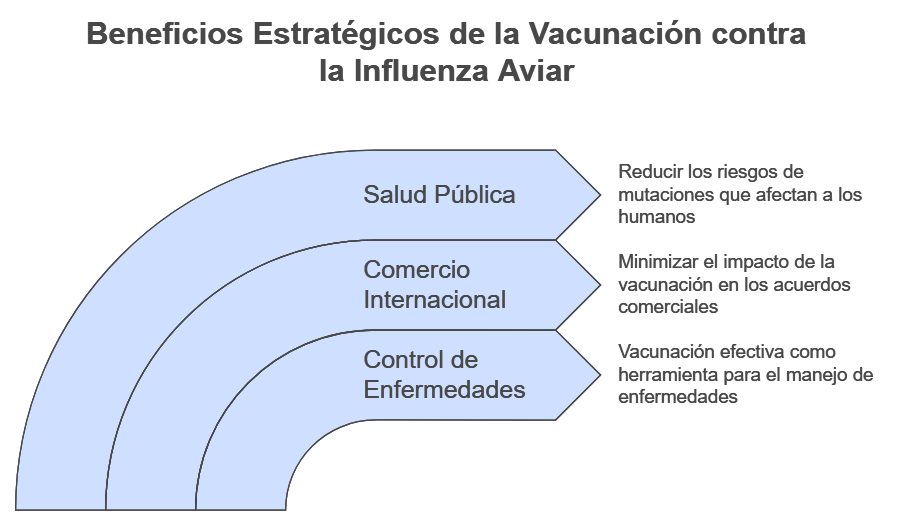
- Disease Control: Effective vaccination can become an essential tool in HPAI control and eradication programmes.
- International Trade: Minimizing the adverse effects of vaccination on trade is a priority, and positive results can facilitate trade agreements and health protocols.
- Public Health: Although HPAI is primarily an avian disease, controlling its spread reduces the risk of potential mutations that could affect humans.
The ultimate goal is to enable large-scale vaccination, taking into account animal and public health, thus protecting birds, people, and safeguarding exports of poultry and genetics internationally.
Finally, it is worth recalling that an important selection criterion for candidate vaccines is the ability to distinguish between vaccine-induced antibodies (production birds with antibodies because they have been vaccinated) and infection-induced antibodies (production birds that generate antibodies because they have contracted an avian influenza infection). This distinction can be made with the three modern vaccines; they meet the requirements of the so-called DIVA principle”, explains Nancy Beerens. The selected vaccines are already on the market in some countries or are in an advanced stage of development. However, further field trials are still needed to reconfirm that these vaccines are effective in preventing disease after infection with the current HPAI H5N1 virus found in Europe and can prevent virus spread among laying hens.
For more information:
-. Avian Influenza on NeXusAvicultura.com