
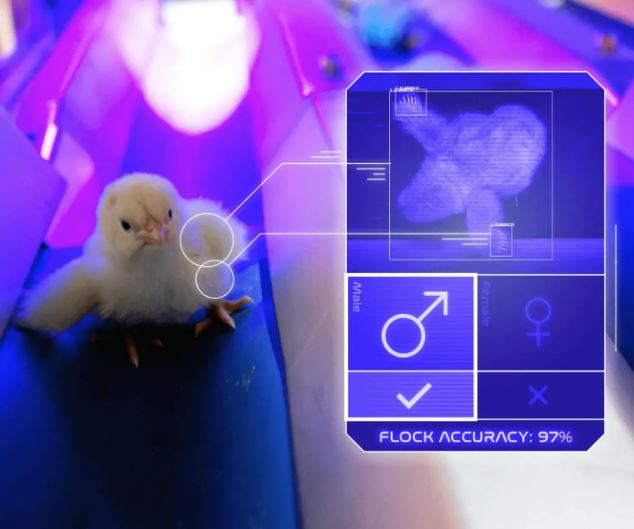
Grupo UVESA has become a pioneer in Spain by automating day-old chick sexing through the incorporation of the gender classification prototype Ceva Genesys at its hatchery in Tudela (Navarra). This innovative technology, developed by CEVA, represents a milestone in the Spanish poultry sector and endorses UVESA’s commitment to implementing cutting-edge systems that improve the efficiency, productivity and sustainability of poultry meat production.
A high-precision, constant-speed sexing system
CEVA’s Genesys technology for automatic chick sexing stands out for delivering a classification accuracy of over 97%, thereby minimising the margin of error associated with traditional manual methods. Furthermore, its modular and compact design – with a footprint of approximately just 5 m² per module – allows installation in reduced spaces and ensures a straight, linear flow of chicks to streamline the operation.
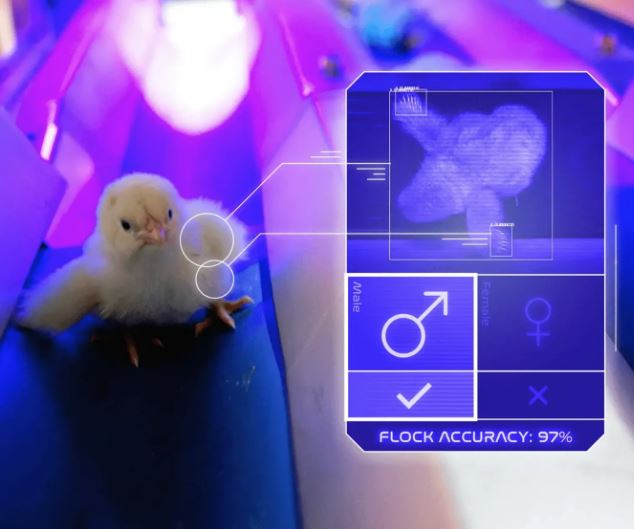
Automation makes it possible to maintain a constant working speed throughout the entire process, eliminating the variability inherent in manual classification.
In conventional methods, sexing typically relies on the visual inspection of each chick’s wing (comparing primary and covert feathers) and is limited to a set number of birds per hour, which requires a large number of skilled operators. With Ceva Genesys, this bottleneck is significantly reduced, while simultaneously addressing the shortage of qualified labour. The most important features of this chick sexing technology are:
Accuracy: Ceva Genesys ensures accuracy of over 97%.
Modular and compact design: The equipment features a compact design that allows installation in any chick processing room, with a footprint limited to 5 m² per module. The chick flow is straight and linear, guaranteeing high classification accuracy.
Remote monitoring and data: The equipment is monitored remotely to identify performance deviations and troubleshoot issues. The system records production results and key indicators, providing access to flock data and equipment performance information at any time.
Alternative to manual classification: Manual gender classification of chicks is carried out by analysing the length of the covert and primary wing feathers. This process is operator-dependent, which affects accuracy and consistency. Manual classification is limited to 2,500 birds per hour, and a large hatchery may require 16 to 20 sexers for each hatch, which is difficult to sustain given that manual chick sexing is a technique requiring considerable experience and training, and chick sexers are an extremely hard-to-find type of worker. Ceva Genesys minimises the risk of error through a powerful algorithm that rapidly identifies males or females, combined with a short separation module.
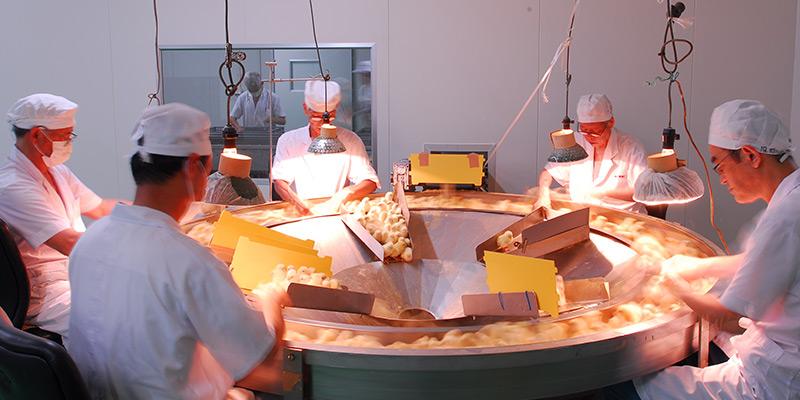
Images such as this one, showing professional sexers separating males and females from newly hatched chicks on a “manual sexing carousel”, could soon become a thing of the past, given the multiple commercial solutions already available for both in ovo sexing of the embryo and automated chick sexing.
Improved uniformity, welfare and sustainability
Separating chicks by sex immediately after hatching brings significant advantages to the production process. Firstly, separate rearing of males and females promotes greater size uniformity within each flock, optimising management at later stages such as slaughter, cutting and packaging. It also allows for more precise adjustment of feeding programmes for the birds, given that nutritional requirements differ between the two sexes. This resource optimisation has a positive impact on feed efficiency, environmental sustainability and the overall profitability of the business.

The Tudela hatchery: a benchmark for innovation
The Tudela hatchery, in operation since 2016 and with a capacity of 1.3 million eggs per week, is the largest in Grupo UVESA. With the installation of CEVA’s automatic sexing prototype, the company reinforces its technological leadership in the Spanish market and strengthens its commitment to quality and food safety.
As Raúl Gómez, CEO of Grupo UVESA, explains: “Automation is one more step in our strategy. We must adapt our production to market demands, which increasingly require calibrated products, and that means being efficient from the very start of production in order to deliver the best product to the customer. Furthermore, maintaining our focus on sustainability, energy efficiency and animal welfare is fundamental to the future of the sector.” It should also be noted that Grupo UVESA has become the most coveted company in Spanish poultry, with two companies seeking to acquire it: the Ukrainian firm MHP and the Spanish GRUPO FUERTES.

CEVA: continuous innovation in the service of poultry production
CEVA, a company with extensive experience in solutions for the poultry sector, has spent years collaborating with hatcheries around the world to modernise critical processes. Technologies such as Laser Life, for beak treatment or in-ovo vaccination, and services such as the C.H.I.C.K. Program have contributed to improving health and performance at numerous facilities.
Now, with Ceva Genesys for broiler chick sexing, the company continues to expand its range of comprehensive solutions for hatchery and poultry production. Ceva also offers other technologies and services for the poultry sector, including:
Poultry vaccines.
C.H.I.C.K. Program vaccination services.
Health monitoring.
The commissioning of this technology at UVESA’s hatchery in Tudela marks a turning point in the industrial-scale automation of automated newborn chick sexing (not to be confused with in ovo sexing), demonstrating that automation and efficiency can go hand in hand.