
AVEC has just published its 2024 Annual Report on trends in the poultry meat sector in September 2024, offering a comprehensive overview of the poultry meat sector in Europe, addressing its achievements, challenges and future strategies. AVEC represents 95% of poultry integrators producing chicken and turkey in Europe, with a key focus on animal welfare, food safety, sustainability and trade. Below we summarise the report’s highlights.

Context and objectives
- Animal Welfare and Production Strategies: AVEC advocates for the production of poultry meat in an ethical and sustainable manner. The organisation bases its policies on science and promotes a balanced approach to production that takes animal welfare into account without compromising the sector’s competitiveness.
- “Farm to Fork and the Green Deal”: These EU strategic plans, driven by sustainability, faced delays due to the COVID-19 pandemic and the war in Ukraine. AVEC stresses the need to avoid regulations that negatively affect the competitiveness of European producers.
- Sustainability in Production: This has become a priority, underpinned by an event held in Brussels in 2023 to showcase the efforts of producers in France, Germany and Spain in improving sustainability.
Poultry meat production and trade
- Gross poultry meat production in the EU decreased from 13,543 million tonnes in 2019 to 13,223 million in 2023, while exports fell from 2,499 million to 1,849 million tonnes over the same period.
- Imports and consumption: imports increased slightly, from 848,000 t in 2019 to 875,000 t in 2023. Domestic consumption rose from 11,886 million to 12,244 million tonnes, with per capita consumption of 23.8 kg in 2023.
- EU self-sufficiency: decreased from 113.9% in 2019 to 108% in 2023, reflecting the fact that domestic demand is not fully met by local production.
Key challenges
- Highly Pathogenic Avian Influenza (HPAI): remains a major threat to the industry. AVEC highlights vaccination efforts in countries such as France, the Netherlands and Italy, although related issues persist in international trade.
- Impact of the European Chicken Commitment (ECC): An independent study in 2024 has revealed that adopting ECC animal welfare standards could significantly increase production costs and price consumers out of the market. Furthermore, this would lead to an increase in imports from countries with lower standards.
Global trends and future outlook
- Growth in global poultry meat consumption: According to the OECD-FAO 2024-2033 report, a 15% increase is expected by 2032. This growth is driven by demand in Asia and Latin America, although Europe will experience a more modest increase (4%).
- Poultry meat production in other countries: Brazil, China and the United States remain the world’s leading poultry meat producers, with Brazil producing 15,445 Mt and the United States 24,123 Mt in 2023.
Sustainability and animal welfare
- Sustainability events: In 2023, AVEC organised an event on the subject, highlighting practical case studies of improvements in sustainable production practices across Europe. The aim is to strike a balance between environmental, social and economic impact to ensure the sector’s viability.
- Animal welfare in transport: AVEC remains engaged in discussions on the European Commission’s proposal to improve transport conditions, advocating for outcome-based indicators grounded in scientific evidence to ensure the economic viability of policies.
European initiatives and research projects
- AVEC participates in multiple European projects, such as MOZART (artificial intelligence for the handling of poultry products) and BREADCRUMB, which aims to reduce food waste and increase sustainability throughout the production chain.
- Promotional campaigns: Initiatives such as “European poultry: a sustainable choice” seek to promote the consumption of European poultry meat and raise awareness of the sector’s sustainable practices.
Production, trade and consumption statistics
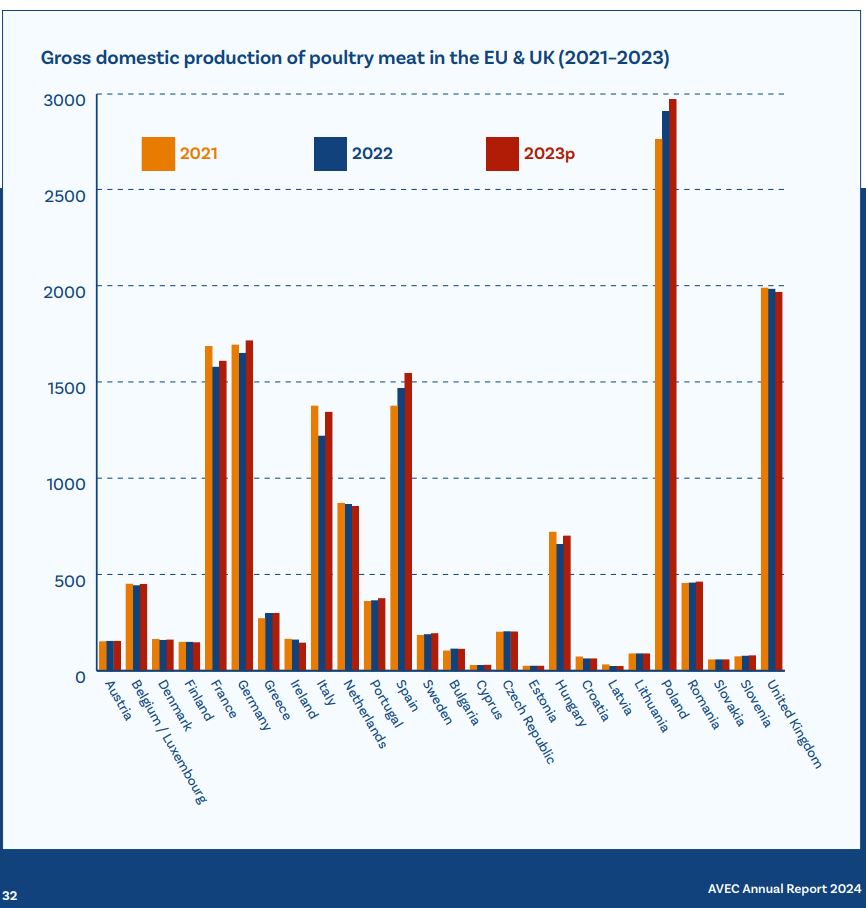
- Production by country: Poland, Spain and France are the largest poultry meat producers in Europe. Poland leads with 2,970 Mt in 2023.
- Per capita consumption: Portugal has the highest poultry meat consumption in the EU, at 39 kg per person in 2023, while Germany records one of the lowest levels at 19.9 kg.
- International trade: EU poultry meat exports have fallen significantly over the past five years, while imports have increased slightly, mainly due to the liberalisation of imports from Ukraine.
Impact of trade with Ukraine
- The liberalisation of poultry meat imports from Ukraine has been a concern for European producers, who fear unfair competition. Temporary measures have been introduced to limit import volumes and prevent distortions in the European market.
Key statistics:
- Gross poultry meat production in the EU (2019-2023):
- Production: EU poultry meat production decreased from 13,543,000 t in 2019 to 13,223,000 t in 2023.
- Exports: Poultry meat exports fell from 2,499,000 t in 2019 to 1,849,000 t in 2023.
- Imports: Increased slightly from 848,000 t in 2019 to 875,000 t in 2023.
- Consumption: Domestic consumption grew from 11,886,000 t in 2019 to 12,244,000 t in 2023, with per capita consumption of 23.8 kg.
- Poultry meat production by country (2021-2023):
- Poland: Remains the largest producer, with output rising to 2,970,000 t in 2023.
- Spain: Production grew to 1,544,000 t in 2023.
- France: Produced 1,607,000 t in 2023.
- Other significant producers include Germany (1,713,000 t) and Italy (1,342,000 t).
- Per capita poultry meat consumption in the EU (2023):
- The EU average was 23.8 kg per person.
- Portugal had the highest consumption, at 39 kg per person.
- Germany had one of the lowest levels of consumption, at 19.9 kg per person.
- Germany had one of the lowest levels of consumption, at 19.9 kg per person.
- Self-sufficiency:
- EU self-sufficiency fell from 113.9% in 2019 to 108% in 2023, reflecting an increase in domestic demand not fully covered by local production.
- EU self-sufficiency fell from 113.9% in 2019 to 108% in 2023, reflecting an increase in domestic demand not fully covered by local production.
- Poultry meat production in other countries (2023):
- Brazil is the largest producer, with 15,445,000 tonnes in 2023.
- China produced 22,622,000 tonnes, making it the world’s largest producer.
- USA reached 24,123,000 tonnes, consolidating its position as one of the leading producers.
Conclusions
- Production and trade trends: Over the past 5 years, the EU has seen a slight decline in its poultry meat production and exports, while consumption has increased, reducing its self-sufficiency. The leading producers in Europe remain Poland, Spain and France.
- Imports and exports: The former have grown slightly while the latter have fallen significantly, implying a growing reliance on domestic production to meet demand.
- Regional differences: There is notable variability in per capita consumption among EU countries, with Portugal and Spain leading in terms of consumption and Germany showing lower per capita consumption.
For further information:
AVEC 2024 Annual Full Report (52 pages)