One of the aspects of broiler management that has been under investigation for several years is the possible advantages of organising hatching on the same farm where the birds will be reared, and the early feeding of chicks that this entails, with fertile eggs transferred at 18 days of incubation.
Another topic also subject to recent discussion is the placement of certain “enrichments” in the rearing house with the aim of improving welfare and performance.
Both aspects together have been deemed sufficiently important to warrant thorough investigation in a study conducted by a team from the Institute of Animal Welfare and Husbandry at the University of Celle (Germany) and Wageningen Research (the Netherlands).
Their findings are presented in a paper that we summarise here to highlight the study design and its most noteworthy results.
“On-farm hatching led to higher body weight throughout the rearing period, highlighting the importance of early access to adequate nutrition.”
What was investigated?
Alternative hatching systems for broiler chicks, compared with conventional hatchery hatching, have been shown to have beneficial effects on broiler welfare, with three companies already offering the equipment required to place fertile eggs in rearing houses after 18 days of incubation, allowing them to hatch there over the following 3 days.
Furthermore, since the improvement of welfare in fast-growing broilers through certain enrichments in the rearing house is currently under discussion, we also wished to investigate this topic in combination with the above.
“Although elevated platforms did not improve walking ability, they did significantly increase overall activity, suggesting an improved state of wellbeing in the broilers.”
How was the study conducted?
With the aim of analysing both aspects jointly, a trial was conducted using a batch of fertile eggs from Ross 308 breeder flocks, incubated together for 18 days and then separated into 2 groups: one placed in a hatcher to hatch conventionally (HI) and the other transferred to the rearing house where they would be grown (FH).
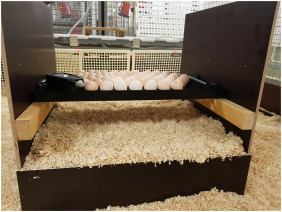
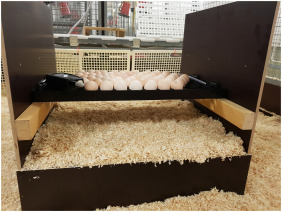
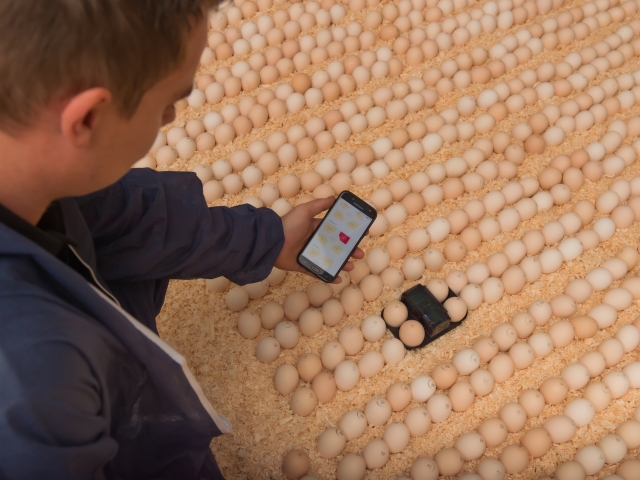
The latter was carried out using a small-scale prototype of the X-Treck system by Vencomatic, with eggs placed approximately 16 cm above the house litter, where they hatched after being maintained at a temperature between 35 and 38°C for the following 3 days under continuous lighting.
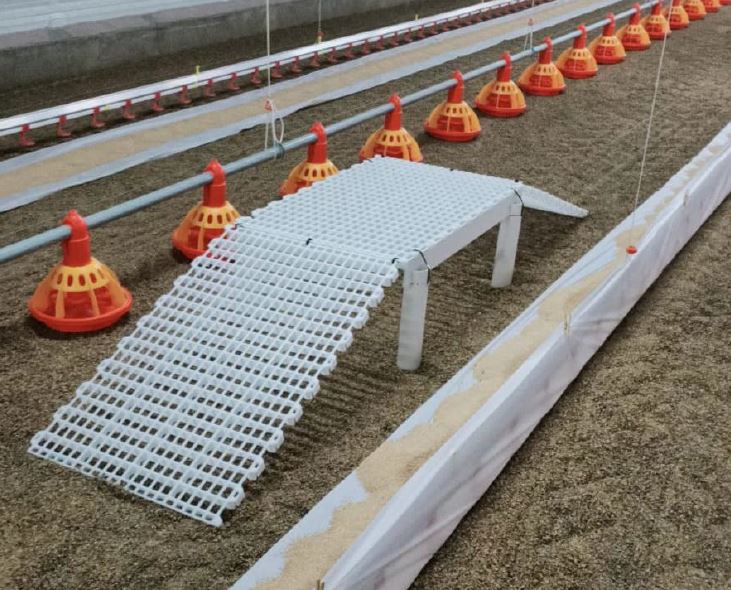
The enrichment studied, installed in half of the pens with on-farm hatched chicks or with those hatched conventionally in the hatchery, consisted of 2 x 0.6 m platforms placed approximately 50 cm above the house litter, fitted with an inclined ramp to allow access (EN), while the other half were reared without such enrichment (NO). Since birds could not shelter beneath the platforms, stocking density was identical for this group compared with the non-enriched group.
A total of 3 rearing cycles of 35 days were conducted using this factorial design, with 2 hatching systems and with or without enrichment. In each case, both sexes were reared separately.
“No interaction was observed between the PLACE of hatching (HATCHERY OR FARM) and the enriched environment, indicating that both factors independently influence broiler welfare and performance.”
Key results: On-farm hatching
- Body weight: On-farm hatched chicks showed higher body weight throughout the entire rearing period compared with conventionally hatchery-hatched birds. This is consistent with other studies highlighting the benefits of early access to feed and water.
- Body temperature: Interestingly, on-farm hatched chicks showed a lower body temperature than hatchery-hatched chicks. This could indicate a better capacity to adapt to fluctuations in environmental temperature, which is critical for bird welfare.
- Platform use: On-farm hatched birds tended to make greater use of the elevated platforms at night. This suggests that on-farm hatching may promote exploratory behaviour and greater use of available environmental resources.
- Hatch rate: Hatch rate did not differ significantly between the two hatching systems.
Key results: Elevated platforms
- Activity: Groups with elevated platforms showed greater overall activity. This is consistent with previous research demonstrating that environmental enrichment stimulates movement and exploratory behaviour in broilers.
- Walking ability: No improvement in walking ability was observed.
- Body weight: Birds in the control group were slightly heavier than those in the enriched group.
Practical implications for a broiler farm
Regarding on-farm hatching:
- Consider the transition: If you are looking to improve body weight in your broilers and potentially their adaptation to heat stress, on-farm hatching is a viable option.
- Implementation: Several commercial on-farm hatching systems are available. Some place eggs directly on the house floor, while others use elevated trays. Research with your integrator which system best suits your facilities and budget.
Regarding the use of elevated platforms:
- Animal welfare: Elevated platforms are an excellent way to enrich your birds’ environment and promote physical activity.
- Design: Platforms should be of an adequate size to allow a significant number of birds to use them simultaneously. The study used platforms that permitted access by approximately 65% of the broilers.
- Material: Choose materials that are easy to clean and disinfect in order to maintain good hygiene standards.
Regarding general management:
- Litter quality: Ensure good litter quality is maintained, adding fresh substrate as necessary to prevent footpad dermatitis and hock burn.
- Stress: Minimise stress during chick handling, especially in conventional hatching systems. Fast transport and careful handling can make a significant difference.
Points to consider
- Interaction: The study found no significant interaction between on-farm hatching and elevated platforms. This means the benefits of each practice are independent of one another.
- Cost-benefit analysis: Carefully evaluate, together with your integrator, the costs of implementing these changes on your farm and compare them with the potential benefits in terms of performance and animal welfare.
- Ongoing research: Poultry science is constantly evolving. Stay up to date with the latest research and adapt your practices accordingly.
Results
No difference was observed between the hatchability of eggs from the HI and FH groups, nor in chick mortality either during the first week of life or over the entire rearing period up to 35 days.
However, a significant difference in body weight was observed throughout the entire rearing period between chicks hatched under the two systems, in favour of the FH (farm-hatched) birds, although this was only significant for females and not for males. These same FH birds showed a significantly lower body temperature than the HI (hatchery-hatched) birds.
“Farm-hatched broilers showed a lower body temperature, potentially indicating better adaptability to varying environmental conditions.”
Observations of bird activity showed that activity in groups with an inclined ramp was significantly higher than in groups without one throughout the entire rearing period, supporting the use of elevated platforms, particularly at night. However, no difference in walking ability was found between hatchery-hatched and farm-hatched chicks, which is explained by the minimal stress experienced by the latter during transport to the rearing house, which was lower than that occurring under commercial conditions.
Use of the elevated platforms was consistently slightly higher among farm-hatched birds than among hatchery-hatched birds, but this did not affect their performance, as no differences were observed in those physical characteristics that might have indicated a different welfare status: plumage cleanliness, footpad dermatitis or breast blisters.
“The study underlines the possibility that innovative husbandry practices in poultry production can improve not only productive performance but also animal welfare.”
Both on-farm hatching and the use of elevated platforms can be valuable tools for improving the welfare and performance of broilers. On-farm hatching appears to offer benefits in terms of body weight and adaptation to heat stress, while elevated platforms promote physical activity. When implementing these practices, remember to consider the specific needs of your farm and maintain a comprehensive approach to husbandry and animal welfare.
Overall, both on-farm hatching and the use of an enrichment element such as elevated platforms can lead to improved bird activity and therefore better welfare, without interfering with one another.
Source:
-. Effect of on-farm hatching and elevated platforms on behavior and performance in fast-growing broiler chickens.
Julia Malchow, Roos Molenaar, Mona F. Giersberg, Ingrid C. de Jong, Bas Kemp, E. Tobias Krause, Lars Schrader
Poultry Science, Volume 104, Issue 4, 2025, 104910, ISSN 0032-5791
For further reading: