
81% of consumers prefer locally sourced eggs for their freshness, quality and support of the local economy. However, when it comes to identifying the origin of an egg, 84% admit they would not know how to do so by reading the code on the shell.
These are the findings of a recent study commissioned by the Federació Avícola Catalana (FAC) in the context of World Egg Day, celebrated today, 10 October.
Preference for local produce continues to grow
Arenys de Mar, 10 October 2025 – The preference for consuming locally produced eggs is an established trend. A decisive 81% of consumers (eight out of ten) choose eggs produced close to where they live. The three main reasons for this choice are product freshness, support for the local economy, and sustainability.
Despite this clear preference, a significant knowledge gap exists: 84% of respondents admit they would not be able to identify the origin of an egg by examining the code printed on its shell. These data come from a recent study on egg consumption in Catalonia commissioned by the FAC, with the aim of understanding consumer perceptions regarding the origin of this food product, its values, and its role in the diet.
Freshness, quality and sustainability as key purchasing factors
The study highlights the importance consumers place on freshness, an attribute directly linked to local provenance. An egg from a nearby farm travels a shorter distance, reducing the time from lay to point of sale. This contributes to:
- Preserving nutritional value.
- Maintaining organoleptic characteristics (flavour, odour, texture).
- Extending shelf life.
Furthermore, respondents consider that choosing locally produced eggs is a way of supporting the local economy, as it encourages job creation in the primary sector and ensures that revenues are reinvested in the community. This practice is also seen as a means of achieving territorial balance, favouring the continuity of traditional economic activities and promoting the preservation of food heritage, resulting in consumption that is more sustainable and beneficial to the environment.
The study also reveals that, although 68% of respondents believe the eggs they consume are of local origin, 28% admit they do not actually know their provenance. The vast majority (81%) have noticed the code on the shell, but 25% confess they do not know what it means and 79% consider it difficult to interpret.

“The code printed on the shell is a fundamental tool for the consumer. It provides key, transparent information about the product being purchased, beyond what may appear on the packaging or in advertising,” states Joan Anton Rafecas, president of the FAC.
“We know that for 81% of consumers, local provenance is an important factor and, therefore, it is our responsibility to equip them with the knowledge to make informed choices. This initiative aims precisely to bridge the gap between what consumers value and what they actually know.”
The trend towards eating more eggs is growing, including at breakfast
The FAC study indicates that egg consumption is widespread, reaching virtually all respondents. In terms of frequency:
- 60% consume eggs 2 to 3 times per week.
- 23% eat them once a week.
- 9% consume them daily.
Women and older consumers tend to eat eggs more frequently than younger men. Despite this, respondents perceive egg consumption as healthy and believe they could eat more. Indeed, 30% consider the ideal weekly consumption to be between 4 and 5 eggs.
According to data from the Ministry of Agriculture, Fisheries and Food, average household consumption in Spain stands at 143 eggs per person per year. Cantabria leads consumption with 193 eggs per person per year. These figures confirm that the egg is a key dietary staple, but consumption still has room to grow.
Regarding consumption occasions, 64% eat eggs at dinner, surpassing lunch (50%). However, a new trend is emerging: more than half of young people and those under 44 years of age (54% of this group) have already incorporated eggs into their breakfast, breaking with more traditional patterns.
Purchasing takes place primarily at supermarkets
The supermarket is the main purchasing channel for almost three quarters of consumers (72%). Nevertheless, consumers diversify their points of purchase:
- 31% also buy eggs at local neighbourhood shops.
- Older consumers and men show a greater tendency to purchase at municipal markets.
The most valued purchasing criteria are size (25%), freshness (16%) and price (16%).
What does the code mean?
The egg code is the series of numbers and letters printed on the shell. This code enables egg traceability, meaning it is possible to identify the exact farm of origin. The digits provide information about the housing system of the laying hen and its country of origin. The egg was in fact a pioneer in food traceability, being one of the first food products to incorporate a mandatory printed code.
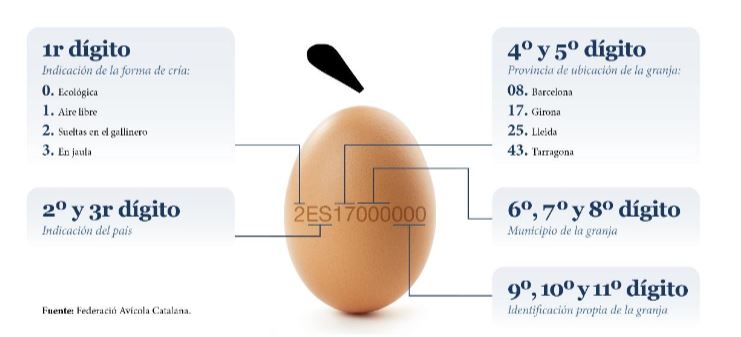
The egg was a pioneer in food traceability, becoming one of the first food products to incorporate a mandatory printed code on its shell.
Details of the FAC study
The FAC commissioned this comprehensive proprietary study based on the opinions of 1,000 citizens in the context of World Egg Day. The objective is to reduce the gap between what consumers value (local provenance and quality) and what they actually know about the origin of eggs. The study also aims to promote a local product that is healthy and nutritionally rich. The study used the Netquest platform, which provides access to a broad panel of genuine online profiles and guarantees sample quality.
This initiative takes on particular relevance this year, as Catalonia holds the distinction of World Region of Gastronomy, a recognition awarded by IGCAT (International Institute of Gastronomy, Culture, Arts and Tourism). This title promotes regions that contribute to improving quality of life through food culture, health education, sustainability and gastronomic innovation.
The poultry sector in figures
Catalonia is a key hub in national egg production, with 4.27 million laying hens producing more than 104 million dozens per year. This figure contributes to Spain’s national total of 1,169 million dozens, placing the country as the third largest producer in the European Union. These data confirm the strategic importance of egg production in Spain and underline the need to improve communication regarding origin and traceability in order to meet consumer demand.
For further information:
-. About the FAC: With almost five decades of history, the Federació Avícola Catalana brings together more than 300 egg and poultry meat producers from across Catalonia. It acts as the sector’s representative body before public authorities and society, championing a production model aligned with the high standards of quality and animal welfare required in the European Union.
-. FAC news on NeXusAvicultura
-. World Egg Day