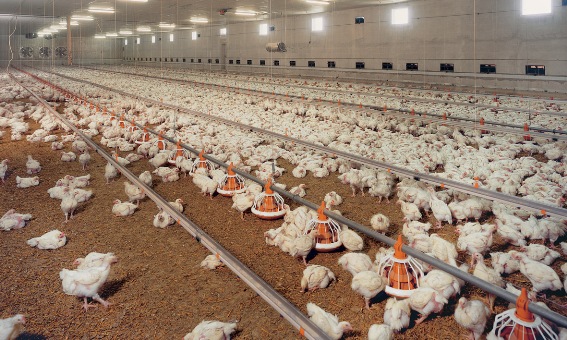

Wouter Bruins was looking for a real-world problem to solve. For his master’s project in cell biology at Leiden University, he needed to find an idea from which a start-up could emerge. To do so, he sought inspiration from farmers in his native Randstad region (Netherlands). One day, while visiting a farmer’s henhouse, the farmer stopped and pointed to the chicks. “For every hen you see here, we have culled a cockerel — a male chick,” the farmer explained. “And I hate that we have to do it.”

He was referring to the approximately 6.5 billion male chicks culled every year worldwide, at just one day old. Egg producers, who also rear laying hens, lack a fast and cost-effective system for determining the sex of an embryo before the chick hatches. As a result, once they hatch, farm staff are responsible for verifying their sex and removing the females. The males are culled immediately, thrown into a macerator or, if they are fortunate, into a gas chamber. “Of all the problems faced by the people I interviewed, I decided to focus on the selective culling of chicks,” Bruins recalls. “It is an issue that combines technological and business challenges, but also ethics. When you see it, you understand that it is not right.”
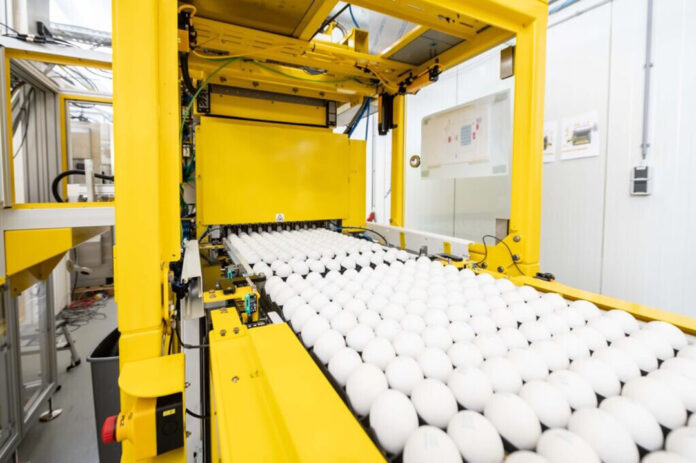
Bruins retreated to his Leiden apartment to search for a solution. Together with his biomedical sciences colleague, Wil Stutterheim, he founded In Ovo, and they have spent 12 years working on a fast and affordable method to enable producers to determine the sex of a fertilised egg. The result has been Ella, a machine that determines the sex of an egg from day nine of incubation, simply by making a hole in the shell and extracting a small fluid sample. The first machine was successfully trialled in 2020 and enabled 300,000 chicks to be hatched without a single male needing to be culled. In Ovo is currently in its expansion phase and plans to have ten machines operating in egg producers’ hatcheries by the end of 2024.
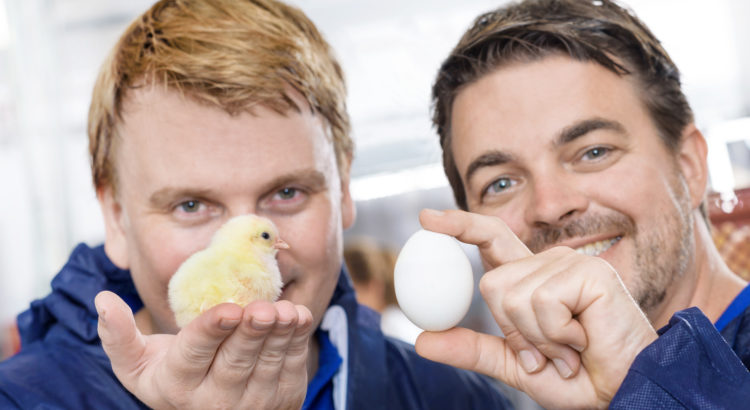
“If you are a biologist, you understand genetics and you also have a connection to the agricultural sector, this is one of those obvious problems that needs to be solved,” explains Diogo Machado Mendes, chief economist in the bioeconomy division of the European Investment Bank. The EU bank is supporting In Ovo with a venture debt investment of €40 million backed by an InvestEU guarantee.
Fast and low-cost testing
This is how the machine determines the sex of chicks: a needle makes a tiny hole in the egg and extracts a small amount of fluid from the sac where the embryo’s waste is deposited. The hole is then immediately sealed with adhesive. The machine takes approximately one second to determine the sex using a mass spectrometer, which searches the sample for a unique biomarker discovered by In Ovo. It then sorts the eggs by sex. Females are returned to the incubator until the egg hatches after 21 days. Males are delivered to a company that uses them as an ingredient in pet food production.
An average hatchery produces approximately 20 million chicks per year, explains Bruins. The challenge facing In Ovo was to make the testing sufficiently cost-effective and accurate for hatcheries to be able to use it. Although technology to determine the sex of an embryo has existed for a decade, it was too costly. “I had the intuition that this could be very big,” he says. “It was something I could dedicate a great deal of time to in trying to solve the problem.”
In Ovo aims to refine the technology further to achieve testing on day six rather than day nine. In addition to determining the sex of an embryo, In Ovo also monitors chick health during incubation. The European Investment Bank funding will enable the company to continue improving its machine, bring more units into operation, and contribute to further innovation in the poultry sector.
Hatcheries also achieve significant labour savings, as a large proportion of chick sexing is carried out manually. The cost of testing a fertilised egg is negligible, which is highly important in a high-volume, low-margin business such as table egg production. “Selective chick culling is something that is truly difficult to witness,” says Céline Rottier, the European Investment Bank loans officer involved in the project. “But the question is: is it possible to find a solution that farmers are willing to adopt? I believe they may have solved this problem.”
A €40 million EIB loan demonstrates the EU’s commitment to in-ovo sexing
The European Investment Bank (EIB) granted a €40 million loan in 2023 to Dutch company In Ovo, an innovative agri-tech company whose objective is to end the mass culling of male chicks in the poultry industry.
This funding, which will also be used to invest in new innovations in the poultry sector, will drive the expansion of Ella, a fast and accurate technology for determining the sex of hatching eggs at an early stage, the company states. With the implementation of this technology, hatcheries can incubate exclusively female chicks. This renders the culling of day-old male chicks unnecessary and improves overall sustainability.