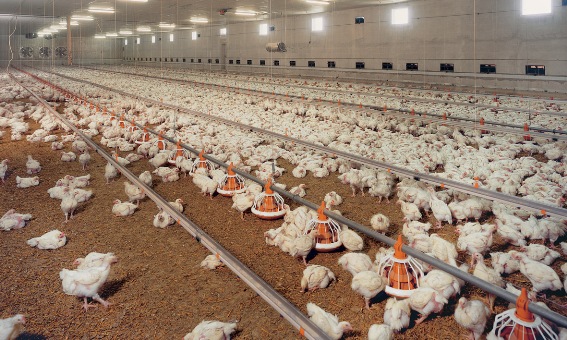

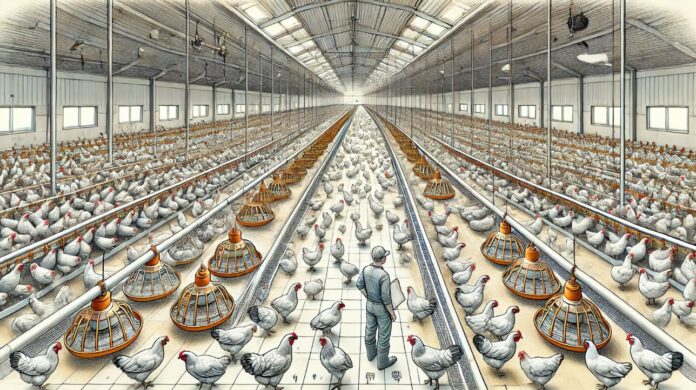
Managing on the basis of the “average” of anything can be a potentially dangerous concept when it comes to broiler growth, as occurs, for example, when ventilating a tunnel-type house with fully grown birds.
In this case it could happen that the average house temperature was 27°C, which is not necessarily a problem, but it would conceal the fact that it could be 21°C at the air inlet pad end and 32°C at the fan end, which would indeed be dangerous.
During cold weather a daily average relative humidity (RH) of 60% seems ideal, but in reality it could be 40% during the day and 80% at night, which could increase the likelihood of respiratory problems. Finally, although birds may have been housed at a relatively low density, that does not necessarily mean that all of them have equal space to eat, drink and move around.
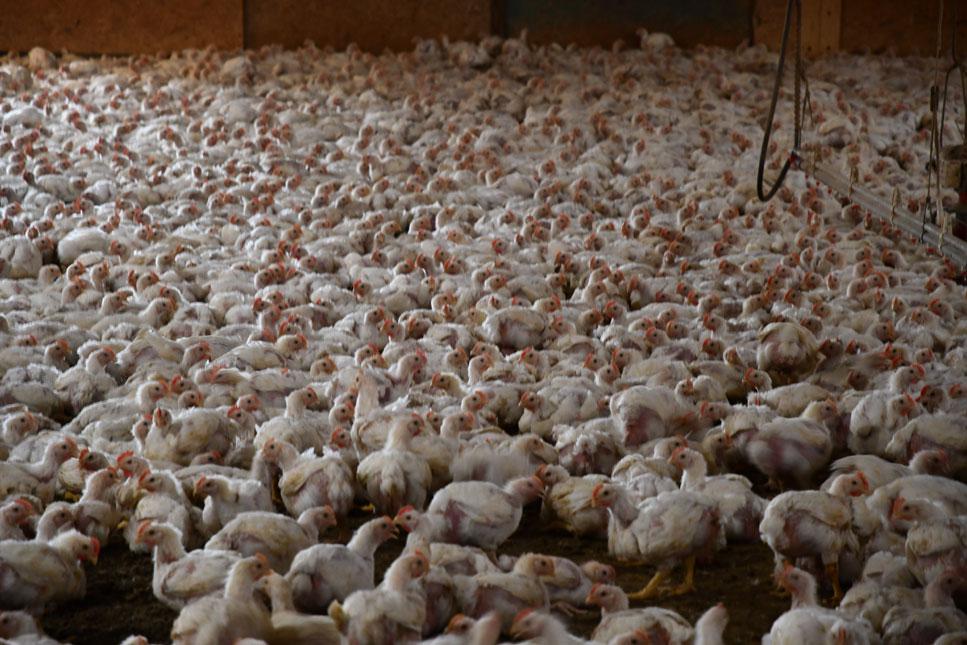
Maintaining a uniform density from one end of the house to the other is of the utmost importance as it affects bird performance in several ways. Differences in density within a house will not only result in differences in the available feeder and drinker space, but also in the effort each bird requires to access feed and/or water.
If there is an excessive number of birds in one area of the house, litter moisture will be higher simply due to the greater amount of wet droppings deposited in it. Furthermore, the higher the density, the lower the air movement over the litter, resulting in reduced litter drying capacity, increased ammonia production and footpad dermatitis problems in the birds.
Overall air quality will also tend to vary in a house with density variations. When fresh air is entering a house it does so uniformly along the inlets. But if there are more birds in one area than another, those birds will receive less fresh air compared with the less crowded birds, resulting in more stale air and less fresh air in that area than in the other.

Heating costs can be affected by differences in stocking density. During cold weather we use the birds to heat the houses. If the birds are not distributed uniformly, our “heaters” will not be distributed uniformly, which in turn creates air temperature differences along the house. You can end up with fans running at one end of the house to cool the birds and heaters switching on at the other end trying to prevent the birds from getting cold.
Last but not least, poor bird distribution can be very costly during hot weather. The higher the stocking density, the less space between birds, causing them to feel hot, consume less feed and gain less weight. In tunnel-ventilated houses, birds tend to be more densely packed in the pad area than at the fan end, for several reasons:
- 1st. Because most broilers are traditionally brooded at the pad end and must be moved towards the fan end. Getting them to move a long distance at the outset is difficult, which results in more birds ending up remaining in this area rather than spreading throughout the entire house.
2nd. Because birds naturally tend to move into the wind, which causes them to move towards the pad end of the house if migration fences are not correctly installed and managed.
- 3rd. Last but not least, because the high light intensities typically found near the tunnel fans, as well as the noise caused by slamming shutters, can cause birds to move away from them and towards the pad end.
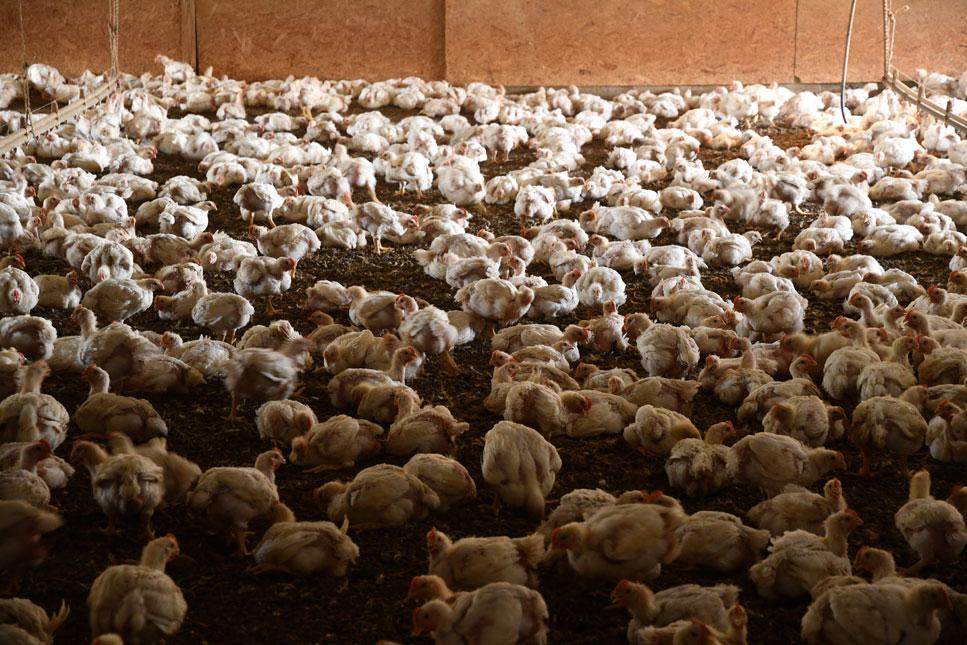
To ensure that broilers are uniformly distributed throughout the house after brooding in a restricted area, it is important to actively move them from this area to the rest of the house, and for migration fences to be installed a few days afterwards. The longer this process is delayed, the more difficult it will be to move the birds from the brooding end to the opposite end.
Having a minimum of two water meters in different areas of the house, and ideally four in some of today’s longer houses, is crucial for monitoring stocking density distribution. If water consumption is not the same at both ends of a house, the density is not uniform: a 20% difference in water consumption equates to an equal difference in bird density.

It is important to realise that differences in stocking density between the pad end and the fan end of a house will often not affect broiler weight gain until the last week or two of the flock. Initially, a 20% difference in density may not affect overall bird performance because the birds are small and there is still sufficient space around feeders and drinkers, and if one area is slightly overcrowded, they can easily move across the width of the house to find easier access to feed and water.
But even more importantly, when broilers are young, even if there are more of them at one end than the other, there will often be sufficient space between them to allow adequate airflow to prevent overheating. But towards the end of the grow-out, when free space is very limited, having 30%, 20% or even 10% more birds at the pad end will dramatically impair their access to feed and water, as well as their ability to lose heat. This will result in birds near the pads gaining considerably less weight towards the end of the grow-out than those at the fan end.
Source:
Michael Czarick and Brian Fairchild. Poultry Housing Tips, vol. 35, no. 8.