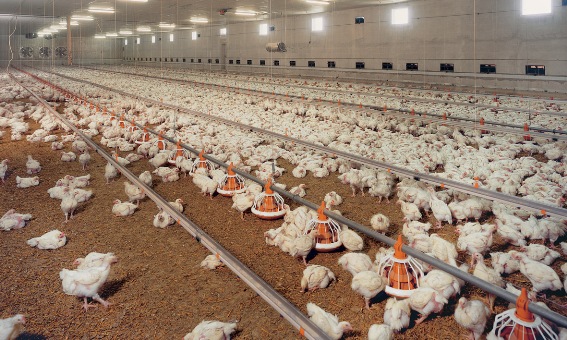


Confirmed: first Highly Pathogenic Avian Influenza (HPAI) outbreak on a commercial farm in Brazil. The affected operation is a broiler breeder unit, with a total of 17,000 birds affected to date.
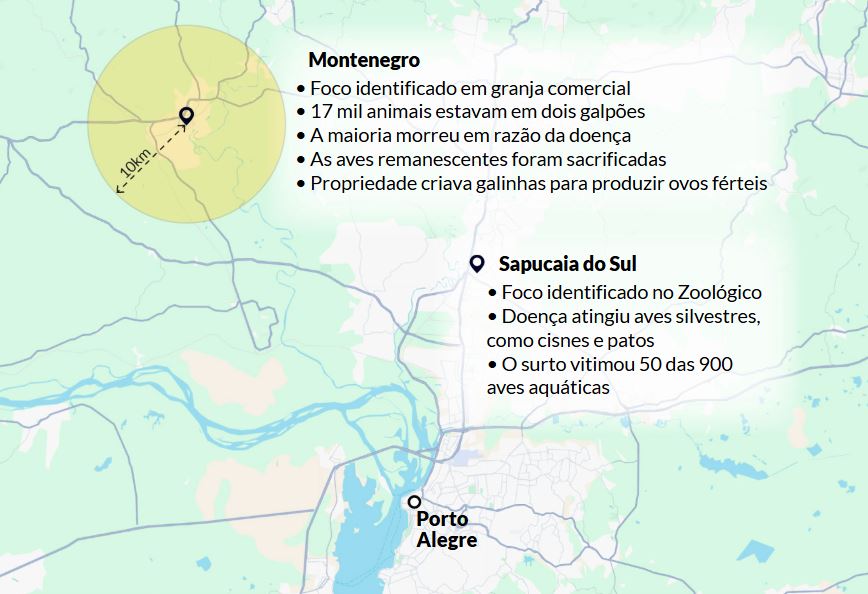
Montenegro, Rio Grande do Sul, Brazil – Brazil’s Ministry of Agriculture and Livestock (MAPA) confirmed on Friday 16 May 2025 the detection of highly pathogenic avian influenza (HPAI), subtype H5N1, on a commercial farm housing 17,000 broiler breeder birds (producing fertile hatching eggs for broiler production) in the municipality of Montenegro, state of Rio Grande do Sul. This event marks the first HPAI outbreak in Brazilian commercial poultry, a sector of great importance to the country’s economy and a key player in the global poultry protein market.
Previously, Brazil had recorded HPAI cases exclusively in wild birds since May 2023. The detection on a heavy breeder farm — which produces fertile eggs for broiler production and operates under stringent biosecurity protocols — has raised alarm throughout the sector. At the affected farm in Montenegro, 100% mortality was reported in one house and 80% in another, leading to the sanitary culling of the surviving birds, estimated at approximately 17,000, to contain the spread of the virus. Additionally, a suspected outbreak is under investigation at a zoo in Sapucaia do Sul, near Montenegro, where dozens of captive birds were found dead.

What containment measures have been implemented?
Following confirmation, the Brazilian authorities activated the National Contingency Plan for Avian Influenza. MAPA has implemented containment and eradication measures at this farm, including a quarantine zone within a 10-kilometre radius around the Montenegro farm, and the suspension of poultry events and trade fairs in Rio Grande do Sul. Tracing and monitoring is under way for eggs from the affected farm that were distributed to hatcheries in the states of Minas Gerais, Paraná, and Rio Grande do Sul itself, with guidance to destroy them as a precautionary measure.
The affected farm is linked to Vibra Foods, one of Brazil’s largest poultry companies, with approximately 800 integrated farms and exports to more than 70 countries.
The Brazilian government has officially notified the World Organisation for Animal Health (WOAH) and its trading partners, reaffirming its commitment to transparency. The Ministry of Agriculture emphasises that the disease is not transmitted through the consumption of properly cooked poultry meat or eggs, and that the risk of human infection is low, occurring primarily in individuals with direct and intensive contact with infected birds.

Immediate impact on Brazilian poultry meat and egg exports
Brazil is the world’s largest exporter of chicken meat and until now remained the only major producer free from HPAI on commercial farms, a status that gave it a significant competitive advantage. The confirmation of the outbreak in Montenegro has had immediate repercussions for international trade.
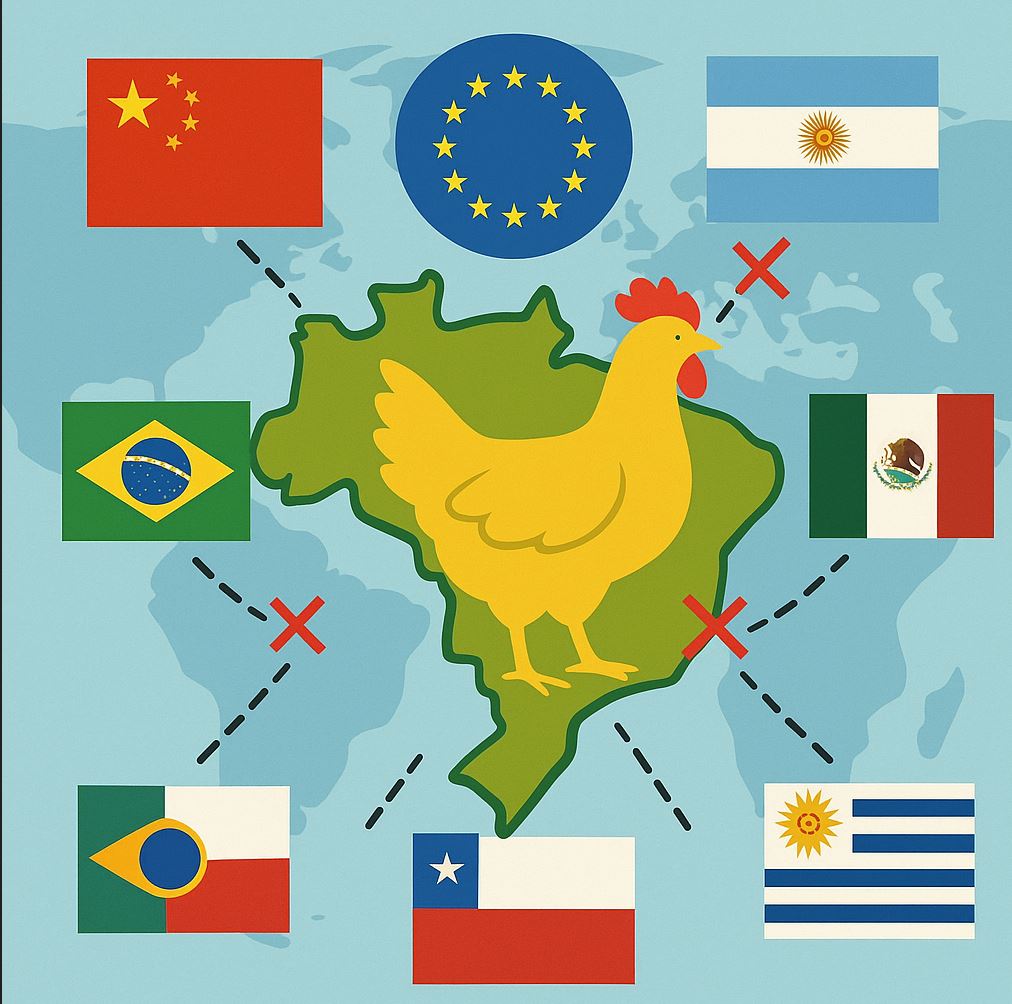
- Export suspensions: China, one of the main destinations for Brazilian chicken meat (accounting for more than 10% of total exports), the European Union, Argentina, Mexico, Chile and Uruguay have temporarily suspended imports of poultry meat and poultry by-products from Brazil. In some cases, these suspensions apply to the entire Brazilian territory under pre-existing trade agreements. Brazilian poultry meat exports to these six markets totalled more than US$235 million in April 2025 alone. As of Sunday 18 May, of the 150 destination markets for Brazilian exports, 14 have suspended imports of fresh poultry meat from all of Brazil.
- Impact on domestic production: Although the Brazilian Animal Protein Association (ABPA) has described the case as “isolated” and is confident of a swift resolution to the trade embargoes, the scale of the impact will depend on how quickly the virus can be contained. The ABPA has also highlighted the need to review sanitary certification models so that they are regionalised, preventing an isolated case from affecting exports from the entire country.
- Prices and supply: Experts identify two possible scenarios for the domestic market. On one hand, the suspension of exports could generate a greater supply of chicken meat on the Brazilian market, putting downward pressure on prices. On the other hand, if further outbreaks are recorded, poultry prices could rise and affect other production chains, such as maize and soybean, the main components of poultry feed. Regarding eggs, a reduction in exports (which account for only 0.9% of Brazilian production) could increase domestic supply and potentially lower prices, whose recent rise was driven by strong demand. However, the poultry sector assures that there is no risk of supply shortages.

No country in the world is immune to avian influenza — hence the critical importance of strict biosecurity programmes implemented under veterinary supervision
The state of Santa Catarina, an important poultry hub neighbouring Rio Grande do Sul, has issued a maximum alert to reinforce biosecurity measures on its commercial farms and has intensified inspection of poultry and fertile egg consignments originating from the affected region. According to data from the Observatório Agro/2023, the integration system predominates in Santa Catarina’s poultry sector. The sector is a productive powerhouse, processing 883.3 million birds per year, of which 870.9 million are broilers, 9.9 million turkeys, and 2.5 million ducks and teal. The agricultural production value (VPA) of Santa Catarina’s poultry sector generated approximately R$12.6 billion in 2023.
Brazil’s Ministry of Agriculture and Livestock and the state agricultural defence agencies are receiving support from bodies such as the ABPA and the Special Avian Influenza Prevention Group (GEPIA) to monitor and control the disease, and have urged the immediate reporting to sanitary authorities of any suspected case of avian influenza.

Further reading:
-. Poultry farming in Brazil
-. Ministério da Agricultura e Pecuária
-. Avian Influenza updates on NeXusAvicultura