

FEFAC publishes its Feed and Food Report 2024 (referring to the year 2023)
The European Feed Manufacturers’ Federation (FEFAC) has published its Final Report on 2023 Feed and Food Consumption for production animals, which focuses on the role of the feed industry as a vital part of the EU feed and food supply chain and its contribution to the livestock and aquaculture economies in the region.
Please note: FEFAC’s “Feed and Food Report 2024“, although bearing the year 2024 in its title, refers to the calendar year 2023 and was published in April 2025. It should be noted that FEFAC publishes various reports throughout the year, with the one summarised here being the final year-end report for 2023.
The Feed and Food Report 2024, published by the European Feed Manufacturers’ Federation (FEFAC), provides a comprehensive overview of the economic trends shaping the European feed sector, highlighting the vital role of the industry within the EU feed and food supply chain and its contribution to the livestock and aquaculture economies.
The current report presents key data for the 2023 calendar year, covering areas such as compound feed production, feed raw material use, industry turnover, as well as meat production and consumption statistics. The industrial compound feed industry is a dynamic sector with slow but steady growth over the past two decades. According to FEFAC, this growth reflects market preferences among livestock and aquaculture producers for efficient compound feeds to meet increasingly stringent performance and quality standards. While the decline recorded in 2020 can be attributed primarily to the withdrawal of the United Kingdom from EU production totals, subsequent decreases in production reflect broader global disruptions. Stating that factors such as the COVID-19 pandemic, geopolitical tensions — notably the conflict in Ukraine — and the environmental policies of member states have had repercussions across the entire EU livestock sector, the federation adds that these challenges have cast a shadow over the EU feed industry, contributing to a recent decline in production.
Key highlights from the report
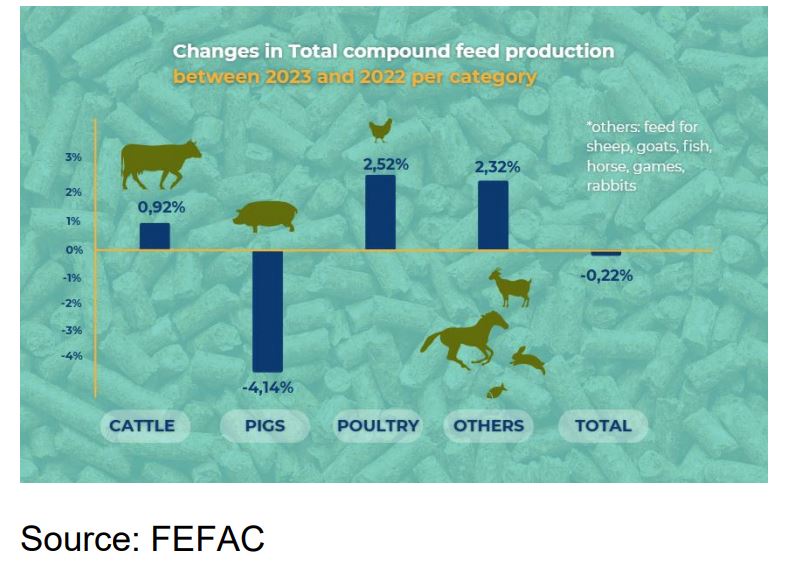
- In 2023, compound feed production in the EU reached 146.9 million tonnes, representing a marginal decrease of -0.22% compared to 2022. This decline was observed in the pig sector, which experienced a notable drop of -4.1%, caused primarily by African Swine Fever (ASF). The poultry sector increased by 2.5% despite the prevalence of animal diseases such as Avian Influenza (AI).
- The EU economy faced significant challenges due to the Russian invasion of Ukraine and the resulting energy crisis, which resulted in elevated inflation and a decline in demand for animal products. Consequently, this fall in demand had a direct impact on feed production.
- In 2023, poultry feed production increased by 1.4 million tonnes due to several factors. The pig feed sector experienced a notable decline, with production falling by almost 2 million tonnes compared to 2022. Cattle feed production increased slightly by 0.9 million tonnes compared to the previous year.
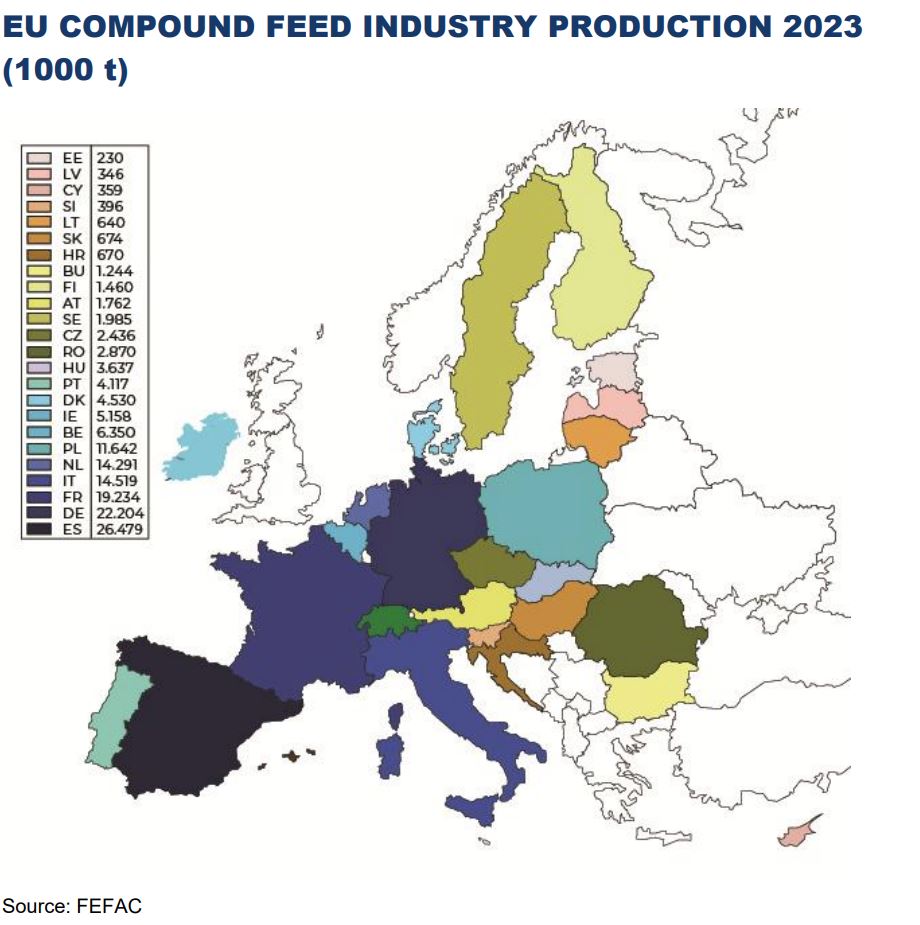
- Spain, Germany and France continue to hold the top positions in compound feed production within the EU.
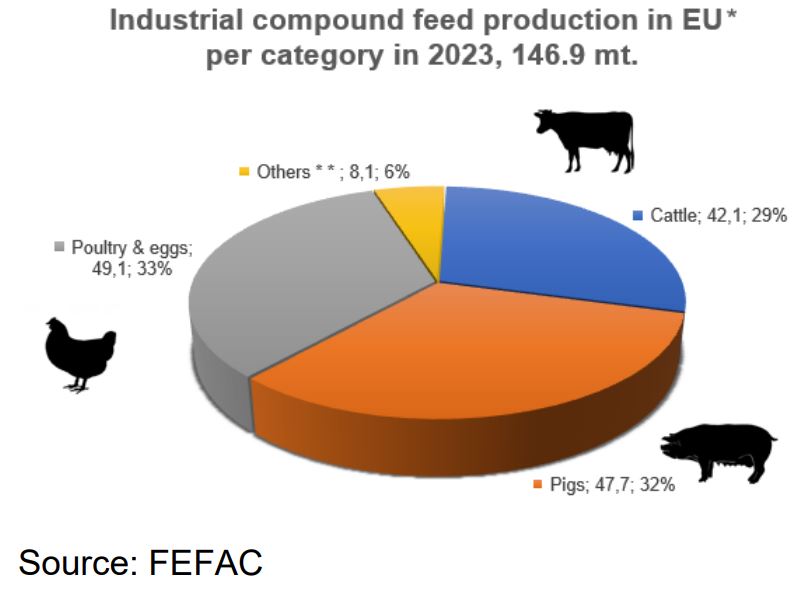
- Overall, and unlike in 2022, the poultry feed sector now stands out as the largest segment of industrial compound feed production in the EU-27, accounting for 49 million tonnes, followed closely by pig feed with 47.7 million tonnes and cattle feed with 42 million tonnes.
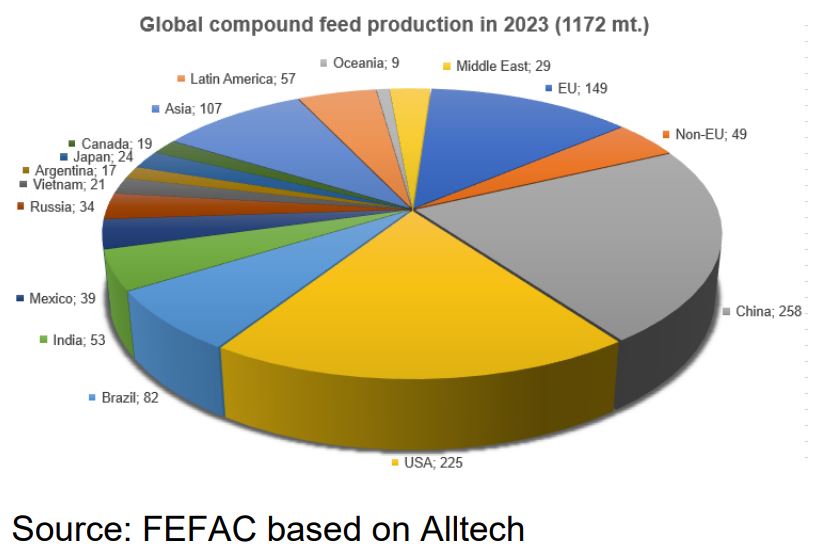
- EU-27 compound feed production accounts for 13% of total global industrial feed production, estimated at around 1,400 million tonnes.
- The EU’s global market share has experienced a 12% decline over the past 6 years, attributed primarily to the notable increase in feed production in Asia-Pacific and North America over the same period.
- Animal feed stands out as the most significant cost factor in livestock production. In 2023, it accounted for up to 50% of the farm-gate value of poultry, 55% of the farm-gate value of pigs, and 17% of the farm-gate value of cattle.
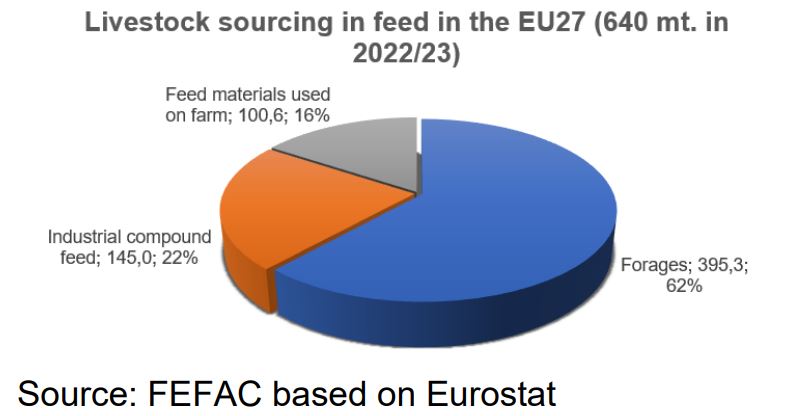
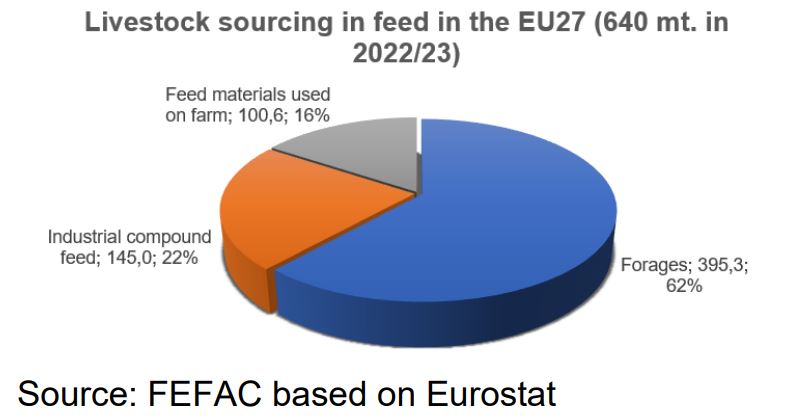
- Annual feed consumption by farm animals in the European Union amounts to approximately 640 million tonnes, comprising both feed raw materials and compound feeds. Of these, 395 million tonnes are forages obtained directly from farms. The remaining 250 million tonnes of feed consumed include cereals grown and used on the farm of origin, as well as feeds purchased by livestock producers to supplement their own resources, encompassing both feed raw materials and compound feeds. It is estimated that approximately 100 million tonnes of feed raw materials are used directly on-farm. Furthermore, in 2022/23, 145 million tonnes of compound feeds were produced, constituting 22% of the total feed basket.
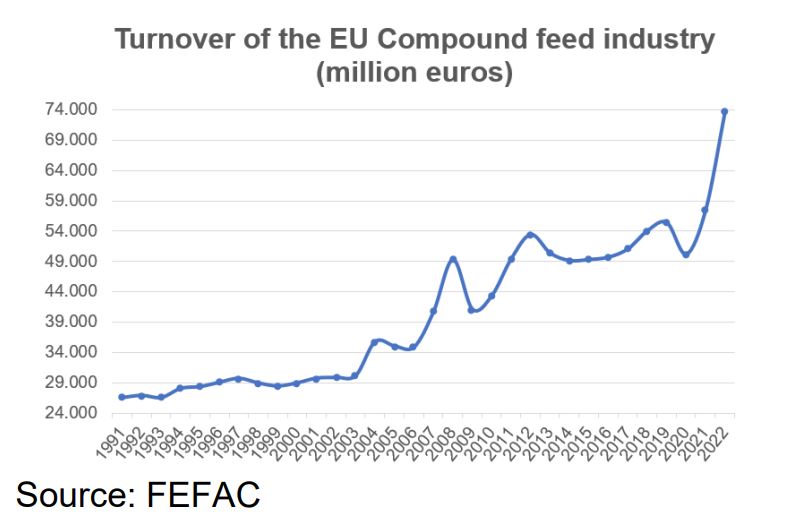
- The turnover of the EU-27 industrial compound feed industry amounted to €73 billion in 2023.
For further information:
-. “Final Feed and Food Report 2024” (published by FEFAC in April 2025, although referring to the 2023 financial year).