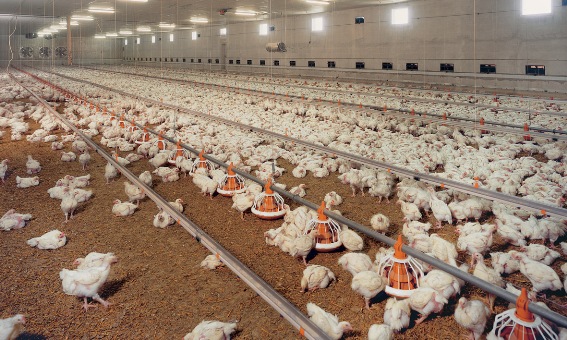


Discover the presentation by Thomas Norton, delivered in Tours at the 15th Poultry and Foie Gras Waterfowl Research Days: “Current status of precision farming for poultry.”
In a particularly competitive context, the challenge for poultry research is to propose solutions that preserve, within the domestic territory, production and processing chains capable of meeting the multiple expectations of retailers, food service operators, and citizens. This event is organised every two years by ITAVI, INRAE, ANSES, and CTCPA, with the support of the French branches of the World’s Poultry Science Association (WPSA) and the World Veterinary Poultry Association (WVPA), two international associations in the poultry sector.

The Role of Precision Livestock Farming: Challenges and the Future of Animal Production
In his presentation “The role of Precision Livestock Farming | Tomas NORTON JRA 2024“, Tomas Norton, a researcher based in Belgium and affiliated with KU Leuven University, explores the concept of Precision Livestock Farming (PLF) and its potential to transform the animal production sector. Norton describes PLF as the digitalisation of the agricultural reality, with the aim of providing farmers with objective data for better decision-making.
However, the livestock sector faces numerous challenges. These include animal diseases such as avian influenza, growing animal welfare concerns, new regulations, and environmental challenges. In addition, internal factors such as the ageing of the rural population and the declining interest of younger generations in poultry farming and livestock production are a cause for concern. This situation is contributing to industry consolidation, with a reduction in the number of holdings but an increase in the number of animals per farm, which may intensify the perception of “factory”-style production and give rise to localised pollution problems.
Norton explains a fundamental equation in animal production: Impact = Efficiency × Production. The initial logic is that by increasing resource-use efficiency (feed, etc.), both the economic and environmental impact are reduced, while also potentially improving animal welfare. Nevertheless, he warns of the Jevons paradox, whereby improvements in efficiency can lead to an overall increase in production, negating or even exacerbating the environmental and welfare benefits.
Despite efforts to improve efficiency through genetics, as in broiler production, problems such as leg weakness emerged until genetics managed to compensate for them. Policy responses in Europe appear to point towards attempts to reduce the number of holdings, stocking density (birds/m²), and towards a technological approach, in which PLF plays a crucial role. PLF seeks to integrate environmental and welfare monitoring into a single approach.
Norton highlights that precision poultry farming goes beyond sensors and artificial intelligence; it is about providing useful data to poultry farmers and other supply chain stakeholders to make better-informed decisions. A key aspect is identifying the value that these data generate. Two levels of information processing are distinguished: one in which key performance indicators (KPIs) are processed to reduce uncertainty in decision-making, and another in which the farmer actually acts on those data.
Examples of early PLF applications are presented. A 2014 study demonstrated how monitoring the indoor climate and its relationship to the thermal comfort of birds could be linked to welfare problems such as footpad dermatitis. A computer vision-based technology was also developed to quantify bird behaviour and detect problems such as poor litter quality or climate control failures. However, this technology, launched on the market in 2012, failed to convince poultry farmers, possibly because it did not derive sufficient practical value for them.
Subsequent research focused on more specific indicators, such as detection of nocturnal restlessness in laying hens as an indicator of red mite infestation. Despite developing a promising tool, the response from egg producers was that they needed broader solutions, such as the detection of cannibalism or crowding. This underscores the challenge of capturing valuable data and demonstrating its usefulness to poultry farmers.

Norton envisions a future with greater adoption of robotics in poultry production, not only for general monitoring but also for carrying out tasks that farmers prefer to delegate, without compromising biosecurity. The success of robotics in dairy cow milking suggests similar potential in the poultry sector. However, in areas such as precision feeding, challenges persist due to the lack of precision in available devices. The premature introduction of unproven technologies can generate resistance from farmers.
In conclusion, Norton emphasises that it is not sufficient to measure general production indicators and expect poultry farmers to make use of the data. The future of PLF depends on the careful integration of technology, in which robotic systems will play an increasingly important role, but always with the involvement of the poultry farmer in the process.
In response to questions from the audience, Norton notes that the profile of the poultry farmer of the future will be more data-oriented, with young people interested in agriculture as an information-intensive sector. Finally, regarding the application of PLF in less intensive production systems, such as free-range poultry farming, Norton acknowledges that it is a more challenging field but one with opportunities such as the use of drones for monitoring and predator detection.