
National Salmonella Control Programme for Broiler Chickens 2025-2027 — 2026 Version
Practical summary prepared by NeXusAvicultura based on the programme published by the Spanish Ministry of Agriculture, Fisheries and Food (MAPA), through the Deputy Directorate-General for Animal Health, Hygiene and Traceability.
1. Background and origin of the programme
Spain has been monitoring and controlling Salmonella in poultry since 1993, initially under Directive 92/117/EEC and subsequently under Directive 2003/99/EC. The qualitative leap came with Regulation (EC) 2160/2003, which required all Member States to establish national control programmes (NCPs) with quantifiable prevalence-reduction targets.
Between October 2005 and September 2006, a Community baseline study was conducted which revealed a prevalence of S. Enteritidis and S. Typhimurium in broiler flocks in Spain of 28.2% (41.2% when all Salmonella serovars were considered).
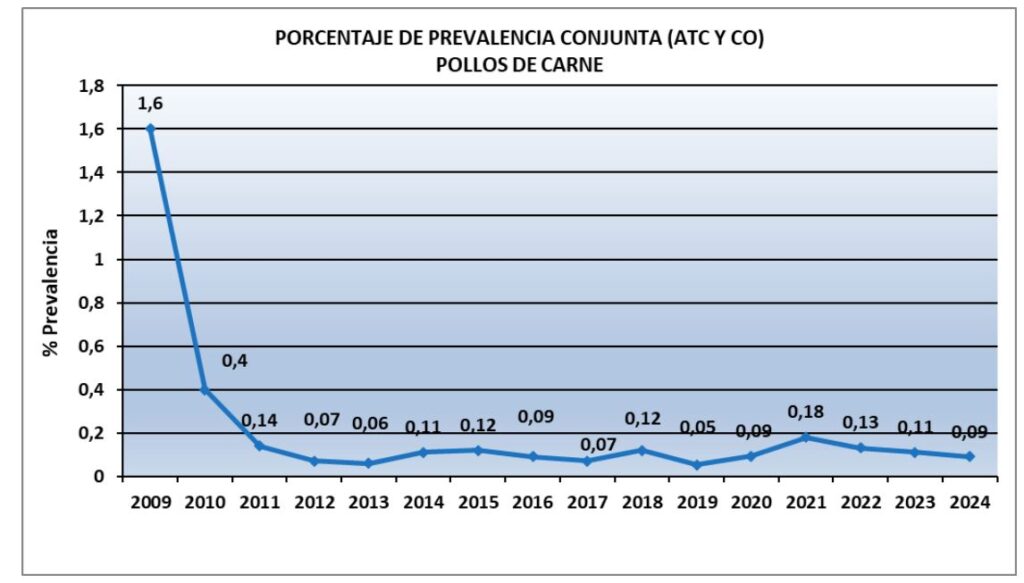
Current result: thanks to successive national programmes, the combined prevalence (self-monitoring + official controls) has declined dramatically. In 2024 it stood at 0.09%, well below the EU target of 1%. Spain comfortably meets the Community objective.
The current programme covers the three-year period 2025-2027 and is implemented in accordance with Regulation (EU) 200/2012. This version corresponds to the update for the year 2026.
“A prevalence of 0.09% in 2024
proves that the BROILER SECTOR
is doing its homework“
2. Objective and definition of a positive case
National objective
- To control the presence of Salmonella Enteritidis (SE) and Salmonella Typhimurium (ST) — including monophasic strains with antigenic formula 1,4,[5],12:i: — in broiler chickens.
- To reduce to ≤ 1% the percentage of flocks positive for these serovars.
When is a flock considered positive?
| Scenario | Result |
|---|---|
| SE and/or ST detected (excluding vaccine strains) | Positive |
| Antimicrobials or bacterial growth inhibitors detected | Positive |
| SE/ST not detected but inhibitory effect on bacterial proliferation present | Positive |
Positive flocks are counted once per batch, regardless of the number of samplings, and are reported only in the year of the first positive sampling.
The objective is clear:
less than 1% of flocks positive
for Enteritidis and Typhimurium.
3. Scope of application
- Territorial: the entire Kingdom of Spain.
- Establishments included: all Gallus gallus broiler chicken holdings destined for commercial slaughter.
- Direct supply establishments (local sales to the final consumer): at least 1 self-monitoring sample per year.
- Excluded: holdings intended for private self-consumption.
Epidemiological unit = the flock
Defined as all birds with the same health status, in the same premises/enclosure, sharing the same airspace and constituting a single epidemiological unit.
Flock identification
Mandatory format:REGA + HOUSE LETTER (uppercase) + DATE OF BIRD PLACEMENT (mmyyyy)
Example: ES123456789012A012026 → REGA + house A + January 2026.
“A positive result for antibiotics
counts the same as
one for bacteria:
zero tolerance.“
4. Reporting of results
- Any positive or suspected Salmonella result (whether within or outside the NCPs) must be reported to the competent authority within 24 hours of the result becoming known, at minimum by the laboratory and by the holding owner.
- The entry of all self-monitoring results into the MAPA computer application (
https://servicio.mapa.gob.es/) is mandatory. - Laboratories must serotype Salmonella spp. isolates to determine whether they belong to the controlled serovars or to others.
- Livestock and Public Health Authorities must share positive results with each other.
5. Biosecurity measures
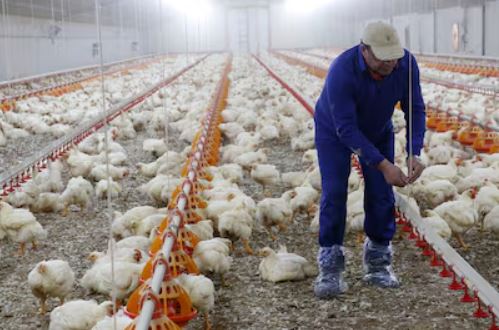
Biosecurity measures are verified once a year using a standardised protocol, at least in all holdings subject to official controls. Ideally, the verification coincides with the official sampling.
Verification protocol: 14 assessed blocks
| Block | Maximum score | Key aspects assessed |
|---|---|---|
| 1. Access control to the holding | 9–12 points | Fencing, vehicle disinfection, visitor log, wild bird access, confinement |
| 2. Maintenance of facilities | 5 points | Maintenance plan, controlled vegetation, house integrity |
| 3. Drinking water control | 2 points | Source (municipal supply or chlorination), covered and protected tanks |
| 4. Manure and waste management | Exclusionary (x0 or x1) | Approved, documented and implemented management plan |
| 5. Carcass and SANDACH management | 4 points | Appropriate system, closed containers, collection from outside the perimeter fence |
| 6. Access control to houses/yards | 9 points | Footbaths, changing rooms, shower, dedicated clothing |
| 7. Bird supply | 11 points | Health documents, breeder flock certificate (free from 5 serovars), hatchery control |
| 8. Feed/raw material control | 13 points | Authorised suppliers, correct storage, certificates of analysis and heat treatment |
| 9. Cleaning, disinfection and pest control (CDC) | 8 points | Documented programme, efficacy analysis, downtime ≥ 12 days (or ≥ 7 with demonstrated efficacy) |
| 10. Rodent and animal control | 11–13 points | Rodent control plan, carried out by an authorised company, exclusion of domestic animals |
| 11. Veterinary medicinal product control | 2 points | Up-to-date medicines register, secure storage |
| 12. Veterinary supervision | 1 point | Responsible veterinarian with recorded visits |
| 13. Management practices and training | 6 points | Code of Good Practice, all-in/all-out system, staff training |
| 14. Self-monitoring | Exclusionary (x0 or x1) | Sampling within the required timeframe (3 weeks before slaughter, 6 weeks if >81 days or organic) |
Exclusionary requirements (score x0 if not met): These are the requirements marked with ** in the protocol. Failure to comply may result in the immobilisation of the holding or the loss of the health authorisation. They include: perimeter fencing, wild bird access to feeders/drinkers, manure management plan, carcass disposal system, CDC programme, downtime, rodent control plan, medicines register, veterinary supervision, code of good practice and all-in/all-out system.
“Biosecurity is no longer optional;
there are requirements that can shut down your farm”
6. Self-monitoring: what, when and how
General requirements
| Aspect | Requirement |
|---|---|
| Flocks to be sampled | All flocks in all holdings covered by the programme |
| Sampling timepoint | Within the 3 weeks prior to slaughter |
| Timeframe exception | Up to 6 weeks for chickens with a production cycle > 81 days or organic production (Regulation 2018/848) |
| Thinning or partial depopulation | Self-monitoring within the 3 weeks prior; if one was already carried out but more than 3 weeks have elapsed, repeat |
| Results before dispatch | All results must be available before the animals leave for the slaughterhouse |
| Responsible party | Holding owner and responsible veterinarian (or qualified laboratory personnel) |
| Post-depopulation environmental sampling | Mandatory after each depopulation; restocking is not permitted until a negative result is obtained |
Recording of results
- Maximum recording deadline in the MAPA application: 1 month from the date the result is obtained.
- Samples/data not entered in the application are not valid within the NCPs.
- Average time from sampling to result: 10–15 days.
Without registration
in the MAPA computer application,
your self-monitoring result has no legal validity.
7. Sampling: step-by-step protocol
Materials and method
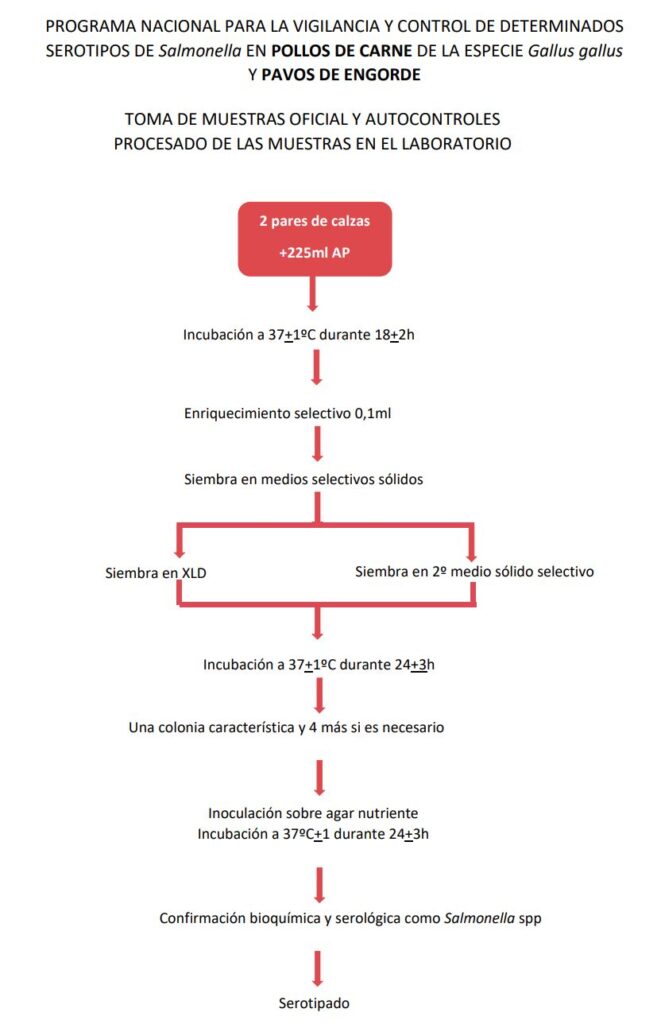
- Use a minimum of 2 pairs of boot covers.
- Moisten the boot covers before putting them on with:
- Maximum recovery diluent (0.8% NaCl + 0.1% peptone in sterile deionised water), or
- Sterile water, or
- Another diluent approved by the NRL.
- Put on the boot covers over the boots.
- Prevent disinfectants from footbaths from contaminating the boot covers (bacterial inhibition).
Special cases
nnnn| Situation | Solution |
|---|---|
| Free-range broilers | Samples taken only from the interior of the house |
| Flocks < 100 birds (no access to house) | Boot covers worn on hands over gloves, rub surfaces with fresh faeces |
Transport and deadlines
nnnn| Step | Deadline |
|---|---|
| Dispatch to laboratory | 24 hours after collection (if not, refrigerate) |
| Transport | Ambient temperature (avoid > 25 °C and direct sunlight) |
| Start of analysis | 48 hours after receipt at laboratory |
| Absolute limit from sampling | 96 hours |
nnnnnnnnn“Two pairs of boot covers
n
and 100% of the surface area:
that is how a valid sample is taken”
8. Official control
nnnnScope
nnnn- n
- Each year: 10% of holdings with more than 5,000 birds, at least 1 flock per holding. nnnn
- In autonomous communities with ≤ 10 holdings: minimum 1 holding. nnnn
- Official sampling is carried out by the official, authorised or accredited veterinarian. nnnn
- An official sampling may replace the self-monitoring of that flock. n
Selection criteria for the 10% (by risk)
nnnn- n
- Characteristics: production type, size, provincial poultry density. nnnn
- History: trend of previous results; priority given to holdings with no information. nnnn
- Non-compliances: higher risk where there are unresolved biosecurity deficiencies or previous positive results. n
9. Laboratory method
nnnn| Element | Specification |
|---|---|
| Reference standard | EN/ISO 6579-1 (Amd1:2020) |
| Enrichment medium | MSRV (modified semi-solid Rappaport-Vassiliadis) |
| MSRV incubation | 41.5 ± 1 °C for 2 × (24 ± 3) hours |
| Boot cover preparation | Immerse in 225 ml of buffered peptone water (pre-warmed to ambient temperature) |
| Serotyping | Minimum 1 strain/positive sample, Kaufmann-White-Le Minor scheme |
| Alternative methods | Permitted if validated according to EN ISO 16140 and registered with the MAPA |
| NRL | Laboratorio Central de Veterinaria (Algete, Madrid) |
| Laboratory accreditation | EN/ISO 17025, accredited tests for all matrices of the PNCS |
Serotyping deadlines
nnnn- n
- Dispatch of isolate to another laboratory: maximum 24 h after isolation. nnnn
- Start of serotyping: maximum 24 h after receipt. nnnn
- Issue of serotyping report: maximum 24 h after result. n
Strain storage
nnnn- n
- Official control strains are stored for at least 2 years. nnnn
- Official control laboratories send all strains to the NRL (Algete). nnnn
- Self-monitoring laboratories send to the NRL the strains it requests. n
nnnnnnnnn“Laboratories have 24 hours
n
to dispatch isolates and 24 h
to begin serotyping”
10. What to do in the event of a positive result
nnnnA) Positive for SE or ST (serovars subject to control)
nnnnMandatory measures (as a minimum):
nnnn- n
- Rigorous epidemiological investigation to identify the source of infection. If a hatchery or breeder flock is suspected, notify the relevant competent authority. nnnn
- Enhanced biosecurity control across all flocks on the holding + verification of self-monitoring records. nnnn
- Standstill: no movement of live birds is permitted, except authorised dispatch for slaughter or destruction, accompanied by an official health document. nnnn
- Restricted marketing: products may only be placed on the market in accordance with food hygiene legislation (Part E, Annex II, Reg. 2160/2003) and Reg. 1069/2009 if not intended for human consumption. nnnn
- Full cleaning + disinfection + insect control + rodent control after the birds have left (including complete removal of litter and droppings). Subsequent collection of environmental samples to verify efficacy. nnnn
- Minimum downtime of 12 days after cleaning, disinfection and pest control. Reducible to a minimum of 7 days if environmental analyses confirm efficacy. Restocking must not take place without a negative result and correction of biosecurity deficiencies. nnnn
- Notify dates to the competent authority: bird removal, disinfection, environmental sampling and restocking. All under official supervision. nnnn
- If deemed necessary, testing of animal care staff to detect carriers. n
B) Positive for another Salmonella serovar (not SE/ST)
nnnn- n
- Rigorous epidemiological investigation. nnnn
- If there are recurring positives and the hatchery/breeder flock of origin is suspected: notify the competent authority. nnnn
- Rigorous biosecurity control across all flocks. n
nnnnn“The minimum downtime is 12 days,
n
unless your analyses indicate otherwise.
11. Slaughterhouse management of positive flocks
nnnn| Farm status | Slaughterhouse action |
|---|---|
| Negative for Salmonella spp. | Routine slaughter |
| Positive for Salmonella spp. (but negative for SE/ST) | Logistical slaughter (last slot of the day) + cleaning and disinfection |
| Positive for SE and/or ST | Logistical slaughter + carcass standstill + targeted sampling (1 sample/flock) + possible restricted marketing |
| No analytical information (incomplete FCI) | Treated as positive for SE/ST by default |
Important for operators: the Food Chain Information (FCI) must always include the results of the last Salmonella analysis under the PNCS. Without this information, the birds are treated as positive for SE/ST.
nnnnnnnnn“If there are no Salmonella results
n
in the FCI, the slaughterhouse
will treat you as positive”
12. Verification of cleaning and disinfection after a positive flock
nnnnEnvironmental sampling protocol
nnnn- n
- Minimum 2 swabs of at least 900 cm² each (per face). nnnn
- Moisten with a suitable diluent (0.8% NaCl + 0.1% peptone, sterile water or another approved diluent). nnnn
- Pass the entire surface of each swab over: floors, walls, feeders, drinkers, extraction fans, beams, pipes, manure belts, scrapers and hard-to-clean areas. nnnn
- Samples may be combined in a single culture or analysed separately and the enrichment then combined (1 ml from each, mix, inoculate 0.1 ml into MSRV). nnnn
- If positive → repeat cleaning, disinfection and pest control until a satisfactory result is obtained. nnnn
- Results: record in the MAPA self-monitoring app, under the outgoing flock. n
Note for routine self-monitoring (non-positive flocks): a minimum of 1 swab of at least 900 cm² is required (instead of 2).
nnnn
13. Feed control
nnnn- n
- Feed business operators must have a documented HACCP system (Reg. 183/2005). nnnn
- Critical points: supplier control, microbiological quality of raw materials, cleaning programmes, storage and heat treatment. nnnn
- There is no harmonised microbiological criterion for Salmonella in raw materials and feeds of plant origin, although one does exist for those of animal origin. nnnn
- If Salmonella is detected in a plant-based product, it is serotyped. If it is S. Enteritidis, S. Typhimurium, S. Infantis, S. Virchow or S. Hadar: notification through the Alert Network. nnnn
- Each year: > 3,000 official inspections of animal feed establishments and > 1,000 official samples for microbiological testing. n
nnnnn“All-in all-out:
n
the system that guarantees the health
of the epidemiological unit”
14. Vaccination
nnnnn- n
- Vaccination is not mandatory. nnnn
- If vaccination is carried out, only vaccines authorised by the AEMPS or the European Commission (Reg. 726/2004) may be used. nnnn
- The following must be recorded in the medicines register: date, vaccine identification, nature, dose, supplier, treated batch. nnnn
- It must also be recorded in the MAPA computer application. nnnn
- Vaccine strains are excluded from the definition of a positive case. n
15. Mandatory records at the holding
nnnnThe operator must keep records available (retained for a minimum of 3 years; the last 12 months must always be kept at the holding):
nnnn| Record | Content |
|---|---|
| Feed | Nature and origin of feed supplied |
| Diseases | Occurrence of diseases affecting product safety |
| Visitors’ register | Entry of persons and vehicles, kept up to date |
| Medicines register | Treatments, vaccinations (RD 1749/1998) |
| Salmonella analysis | All results from self-checks and official controls + hatchery results where applicable |
| Flock register | Entries and exits of flocks (flock sheet: retained for 3 years after disposal) |
| LDD | Protocols and records of cleaning, disinfection, rodent control, insect control + efficacy analyses |
nnnnn“Without registration
n
in the MAPA computer application,
your self-check has no legal validity“
16. Structure of competent authorities
nnnn| Level | Body | Function |
|---|---|---|
| National (coordination) | Directorate-General for Animal Health, Hygiene and Traceability (MAPA) | Programme development and coordination, liaison with the European Commission, data collection and reporting |
| National (laboratory) | Central Veterinary Laboratory (Algete, Madrid) | National Reference Laboratory (NRL) |
| National (inter-administrative coordination) | National Committee of the Veterinary Health Alert System (CNSASV) | Coordination between administrations, epidemiological monitoring, proposal of measures |
| Regional (implementation) | Autonomous Communities (Animal Health services) | Direct implementation: inspections, official sampling, biosecurity verification, designation of laboratories |
17. Historical prevalence: trends 2009–2024
nnnn| Year | SE/ST Prevalence (%) | Meets EU target (≤ 1 %) |
|---|---|---|
| 2009 | 1.60 | No |
| 2010 | 0.40 | Yes |
| 2011 | 0.14 | Yes |
| 2012 | 0.07 | Yes |
| 2013 | 0.06 | Yes |
| 2014 | 0.11 | Yes |
| 2015 | 0.12 | Yes |
| 2016 | 0.09 | Yes |
| 2017 | 0.07 | Yes |
| 2018 | 0.12 | Yes |
| 2019 | 0.05 | Yes |
| 2020 | 0.09 | Yes |
| 2021 | 0.18 | Yes |
| 2022 | 0.13 | Yes |
| 2023 | 0.11 | Yes |
| 2024 | 0.09 | Yes |
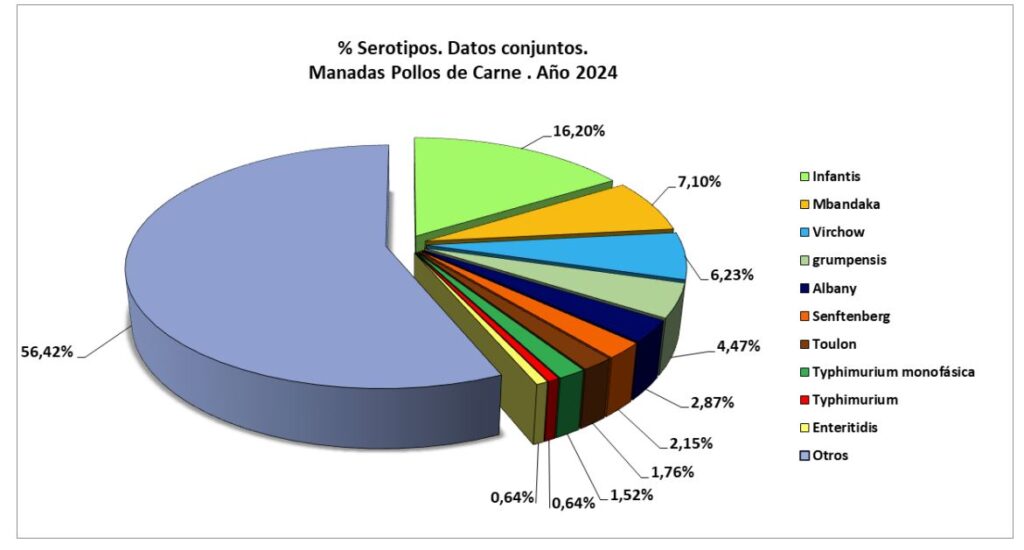
Most frequent serotypes in broiler flocks (2024 data)
nnnn| Serotype | % of total isolates |
|---|---|
| S. Infantis | 16.20 % |
| S. Mbandaka | 7.10 % |
| S. Virchow | 6.23 % |
| S. Grumpensis | 4.47 % |
| S. Albany | 2.87 % |
| S. Senftenberg | 2.15 % |
| S. Toulon | 1.76 % |
| S. Typhimurium monophasic | 1.52 % |
| S. Typhimurium | 0.64 % |
| S. Enteritidis | 0.64 % |
| Others | 56.42 % |
18. Summary of key deadlines
nnnn| Action | Deadline |
|---|---|
| Sampling prior to slaughter | 3 weeks (6 weeks if cycle > 81 days or organic) |
| Notification of positive result to the CA | ≤ 24 hours from becoming aware of the result |
| Dispatch of samples to the laboratory | ≤ 24 hours after collection |
| Start of analysis at the laboratory | ≤ 48 hours after receipt |
| Absolute deadline for analysis from sampling | ≤ 96 hours |
| Dispatch of isolate for serotyping | ≤ 24 hours after isolation |
| Start of serotyping | ≤ 24 hours after receipt at the laboratory |
| Issue of serotyping report | ≤ 24 hours after result |
| Entry of ATC results in MAPA app | ≤ 1 month from obtaining the result |
| Downtime after LDD (positive flock) | Minimum 12 days (reducible to 7 with favourable analyses) |
| Retention of holding records | Minimum 3 years |
| Retention of strains (laboratory) | Minimum 2 years |
| Biosecurity verification | Once a year |
| Operator training (update) | At least every 5 years |
19. Main reference legislation
nnnn| Legislation | Subject matter |
|---|---|
| Regulation (EC) 2160/2003 | Control of Salmonella and other zoonotic agents in the food chain |
| Regulation (EU) 200/2012 | Community target and testing requirements for detection in broilers |
| Regulation (EC) 2073/2005 | Microbiological criteria in foodstuffs |
| Regulation (EC) 852/2004 | Hygiene of foodstuffs (primary production) |
| Regulation (EC) 853/2004 | Specific hygiene rules for food of animal origin |
| Regulation (EC) 183/2005 | Feed hygiene requirements |
| Regulation (EC) 1177/2006 | Specific control methods (antimicrobials and vaccines) |
| Regulation (EC) 1069/2009 | Animal by-products not intended for human consumption (ABP) |
| Regulation (EU) 2019/627 | Official controls on products of animal origin |
| Royal Decree 637/2021 | Basic rules for the organisation of poultry farms |
| Royal Decree 361/2009 | Food chain information (FCI) |
| Law 8/2003 | Animal Health |
Disclaimer / Important notice:
This summary has been prepared by NeXusAvicultura.com based on the official document «National Control Programme for Certain Serotypes of Salmonella in Broiler Chickens of the Species Gallus gallus 2025–2027, Version 2026«, published by the Directorate-General for Animal Health, Hygiene and Traceability of the Ministry of Agriculture, Fisheries and Food (MAPA).
It is for information purposes only and does not replace the legal text, which can be consulted in full (45 pages) on the MAPA website.
nnnn
Further reading:
-. Salmonella in poultry farming
-. Basic legislation and general information on Salmonella Control Programmes
-. MAPA main page on Salmonella Control in poultry farming
-. Summary of the 2026 Salmonella Control Programme for broiler and breeder TURKEYS. (25 March 2026)
-. Summary of the 2026 Salmonella Control Programme for BREEDER hens. (17 March 2026)
-. Summary of the 2026 Salmonella Control Programme for BROILER chickens. (23 Feb 2026)
-. Summary of the 2026 Salmonella Control Programme for LAYING HENS. (17 Feb 2026)
nnnn
Want to stay one step ahead in poultry farming?
Subscribe free to our eNewsletter and receive a weekly selection
of the best information to anticipate trends, stay up to date and grow as a poultry industry professional.
NeXusAvicultura: Vision, Criteria, Quality and Context.