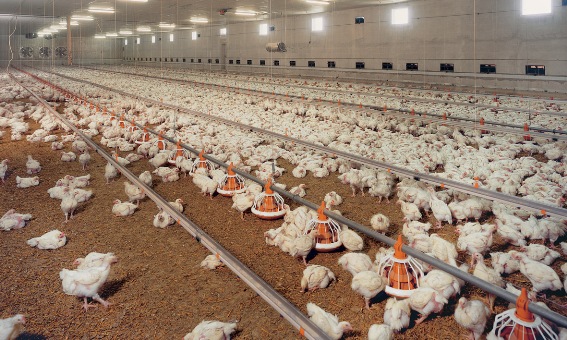

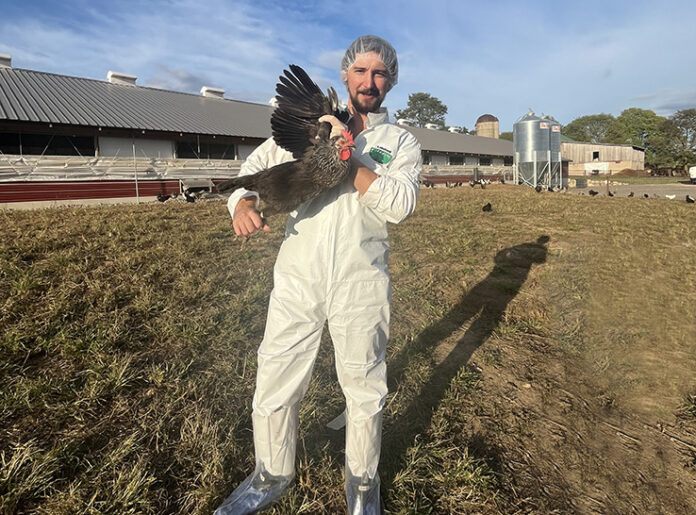
The transition of the laying hen industry towards cage-free systems (cage-free) has presented many challenges and opportunities for poultry producers over the past decade. For laying hen farmers, the management changes that this transition has entailed are significant.
Imagine for a moment if a poultry farmer who had been caring for 100,000 caged laying hens in 2015 were magically transported to a multi-tier aviary housing 100,000 birds in 2026. Without prior training, their “first” day back at work would come as a tremendous shock. Much has changed, yet the basic principles of flock management remain applicable to cage-free hens.
Today, organic and cage-free egg production collectively accounts for approximately 36% of all hens housed in the USA, as reported by the USDA. With this level of production, it is paramount to give special and deliberate consideration to training objectives and workforce competency expectations within the US poultry sector, and in any country that is transitioning to cage-free systems.
To put it plainly, it is essential to update the professional competencies of laying hen farmers and to have a clear understanding of the three requirements detailed below when hiring new poultry workers. Laying hen farmers — whether salaried or self-employed — need to update, expand, and improve their skill sets to manage hens that are no longer raised in cages.
The management and production of eggs in cage-free systems is inherently more complex, encompassing intra-flock dynamics, the inherent pressures of the surrounding aviary environment, and accurate data collection.
This applies to poultry farmers in the USA or in any other country.
The information presented in this article is neither groundbreaking nor limited to cage-free production. However, I firmly believe that a reassessment of the essential skills every poultry farmer must possess is needed. With regard to the competencies described below, I place particular emphasis on middle-management employees, such as flock supervisors, because this specific segment of our workforce has a unique balance of weekly managerial responsibilities and direct contact with the birds. Although they may hold different titles and levels of authority within an egg company — flock supervisor, field technician, and farm manager — their roles are uniformly familiar throughout the poultry industry.
COMPETENCY No. 1: Data Management
Depending on the level of responsibility assigned to middle-management employees, a certain industry-standard level of competency in poultry husbandry (management) should be expected. The first core competency to discuss is data management.

One of the most important determinants of successful cage-free egg production is the immediacy of access to real-time zootechnical data — for each flock and for the entire set of houses on the farm — on the part of the farmer and the management team. Every supervisor-level employee must be able to calculate basic flock health metrics and understand their relationship to performance. Minimum requirements for understanding flock data include a thorough grasp of the current dashboard and the vital signs of each house on the farm.
1.1 – Flock Profile (Identification)
The flock profile refers to the identification information for the flock and includes the flock name, population, age, production category, house type, feeding type, and breed. Below are two examples of a flock profile for pullets and laying hens:
Pullets: House 1 currently holds Flock 102A, a group of 149,800 birds at 8 weeks of age, aviary-style, cage-free, conventionally fed Dekalb Whites.
Laying hens: House 3 currently holds Flock FRO9, a group of 22,790 birds at 40 weeks of age, aviary-housed, free-range, organic Hyline Browns.
The flock profile may sound simple, but it is a mandatory piece of information that is sometimes overlooked by poultry teams. Every responsible employee should have this information memorised and readily available for presentation during professional communications, because any discussion about flocks must be preceded by the listed descriptors. An analogy I like to use is this: if a parent has four children, they should at the very least know their names, ages, dietary restrictions, and hair colour without even having to think about it.
An analogy I like to use is this: if a parent has four children, they should at the very least know their names, ages, dietary restrictions, and hair colour without even having to think about it.
1.2 – Vital Signs
Vital signs encompass 10 core measurements for laying hens and are essential for proper management. These data points must be as current as possible, accurate, and readily available for team discussion and analysis.
None of the vital signs makes sense in isolation; they are intimately interdependent for high-level flock performance. These 10 core vital signs include those listed below:
- Body weight: Required to sustain performance; weighed weekly.
- Uniformity: Indicates flock homogeneity; calculated weekly.
- Hen-day production: Indicates current flock health and performance; measured daily.
- Current mortality rate (weekly/daily): Indicates current health of each flock; calculated as a percentage and analysed as a daily and/or weekly rate.
- Cumulative mortality rate: Indicates health to date; calculated as a running percentage.
- Feed consumption per 100 birds: An indicator of overall flock health; calculated daily and averaged weekly.
- Water consumption per 100 birds: The most important nutrient. Indicates flock health; calculated daily and averaged weekly.
- Egg case weight: Indicates metabolic control; standard case of 30 dozen (360 eggs) or X dozen (the key is to always use the same reference), measured at least weekly.
- Eggs/hen housed: The single most important metric for overall group performance as birds age. Dependent on viability and hen-day egg production.
- Percentage of floor eggs: Allows us to measure how well or poorly we have trained our birds to lay eggs in the nest, as well as environmental conditions; calculated daily and averaged weekly.
Returning to the flock profile examples, let us now add the vital signs:
Pullets: House 1 currently holds Flock 102A, a group of 149,800 birds at 8 weeks of age, aviary-style, cage-free, conventionally fed Dekalb Whites. They weigh 600 grams and have 80% uniformity, with a daily mortality rate of 0.01% and a cumulative mortality rate of 1.2%. They are consuming 4.08 kg/100 birds and drinking 9.08 litres/100 birds.
Laying hens: House 3 currently holds Flock FRO9, a group of 22,790 birds at 40 weeks of age, open-floor, free-range, organic Hyline Browns. They weigh 2 kg and have 86% uniformity, laying at 93%, with a daily mortality rate of 0.02% and a cumulative mortality rate of 2.3%. They are consuming 11.34 kg/100 birds and drinking 20.82 litres/100 birds, with a case weight of 22.22 kg per 30 dozen (one egg case), a production of 134 eggs/hen housed, and 1% floor eggs.
The cage-free team’s ability to collect data is only as valuable as the extent to which that information can be shared and analysed among key decision-makers. Communication of flock performance indicators takes place in both formal and informal settings, such as weekly production meetings and daily conversations. However, truly useful communication includes the complete flock profile and vital signs. Anything less is an incomplete starting point for accurate analysis.
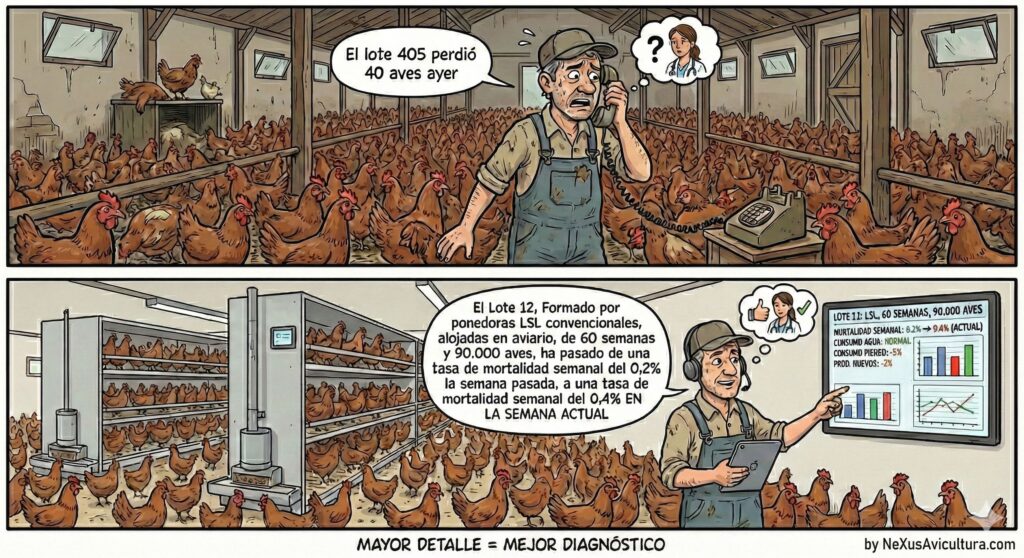
For example, calling the farm veterinarian to report that “Flock 405 lost 40 birds yesterday” is far less valuable than opening the call with: “Flock 12 consists of conventional LSL laying hens housed in an aviary, at 60 weeks of age with 90,000 birds, and has gone from a weekly mortality rate of 0.2% last week to a weekly mortality rate of 0.4% this week.” The latter case presentation format is far more useful and is completed with the addition of the remaining flock vital signs.
When calling the farm veterinarian,
A PROFESSIONAL POULTRY FARMER, INSTEAD OF SAYING:
“Flock 405 lost 40 birds yesterday“
WILL SAY:
“Flock 12, comprising conventional LSL laying hens housed in an aviary, at 60 weeks of age with 90,000 birds, has gone from a weekly mortality rate of 0.2% last week to a weekly mortality rate of 0.4% IN THE CURRENT WEEK.”The latter case presentation format is far more useful and is completed with the addition of the remaining vital signs OF THE FLOCK.
COMPETENCY No. 2: Knowing How to Accurately Assess Each Flock
nnnnThe ability of flock managers to accurately assess the condition of the flocks in their care is both an art and a science. Although nothing replaces time spent around birds and on-farm experience, there is a systematic way to evaluate the behaviour and physical condition of birds. At a minimum, distinguishing normal from abnormal is the required starting point for good husbandry.
nnn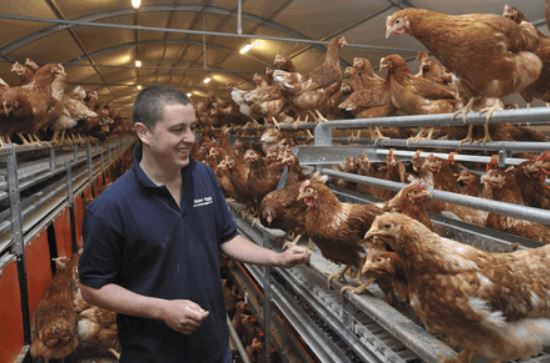
Cage-free flocks exist in three dimensions: front to back, side to side, and bottom to top. It is essential to observe bird behaviour from each of these dimensions within the house environment to ensure an accurate assessment of the group as a whole.
nnnnSupervisors must be able to communicate whether birds are distributed evenly or unevenly throughout the house. This pattern recognition applies to the location of mortality, feeding and drinking behaviour, egg laying, and general congregation. The uniformity of available resources, such as feed, light, air, water, and space (FLAWS), is another important aspect of flock assessment. Finally, individual bird behaviour must be appreciated in terms of activity level, nervousness, feather pecking, aggression, and mobility.
nnnnThe physical condition of birds can be professionally assessed using four of the five human senses (excluding taste):
nnnn2.1 – Visual
nnnnBirds should be examined from “beak to toe”: clean faces; appropriate comb development; feathered necks, backs, and tail bases; clean vents; and normal legs. Abnormal signs of problems in birds that should be noted by supervisors include, but are not limited to, ocular-nasal discharge, squinting, facial swelling, shrunken combs, warts, external blood, feather loss, excessive scabs, prolapses, diarrhoea staining, mites around vent feathers, and bumps on legs and feet.
nnnn2.2 – Auditory
nnnnBirds should be listened to attentively at every opportunity. This is especially useful at night when flocks are quiet and on the perches, because mild respiratory problems can be heard more easily during the calm provided under the cover of darkness. Lively chicks should be chirping, and active hens generally “converse” constantly throughout the day. Any snicking, coughing, gurgling, or wheezing is abnormal and must be communicated immediately to the appropriate chain of command.
nnnn2.3 – Olfactory
nnnnSupervisors can and should be able to discern whether feed, water, and litter generally smell “normal”. Over time, a certain level of self-calibration occurs for each caretaker, ideally to the degree that they can identify whether feed is rancid, water smells off, or ammonia levels are elevated.
nnnn2.4 – Touch
nnnnAlthough flock observation can be done passively during a walk-through of the house, nothing replaces handling as many birds as possible. Using the same “beak to toe” approach, individual birds should be handled to assess whether they have any facial swelling or oral ulcers, crops full of feed and water, external wounds, straight and robust keel bones, adequate breast musculature, open “hip bones”, excessively hot shanks, or foot abscesses. Knowing what is normal versus abnormal is incredibly significant for the early identification of problems, which will subsequently trigger further investigation by the flock veterinarian, nutritionist, and/or production manager.
nnnnTaken together, the competent supervisor should be able to identify deviations from normal flock behaviour and appearance within 1 day of the onset of the abnormality. This is extremely valuable, as early identification allows for earlier investigation and interventions, which are generally more rewarding. It is even better if a supervisor can detect deviations in flock data that typically precede any manifestation of clinical disease.
nnn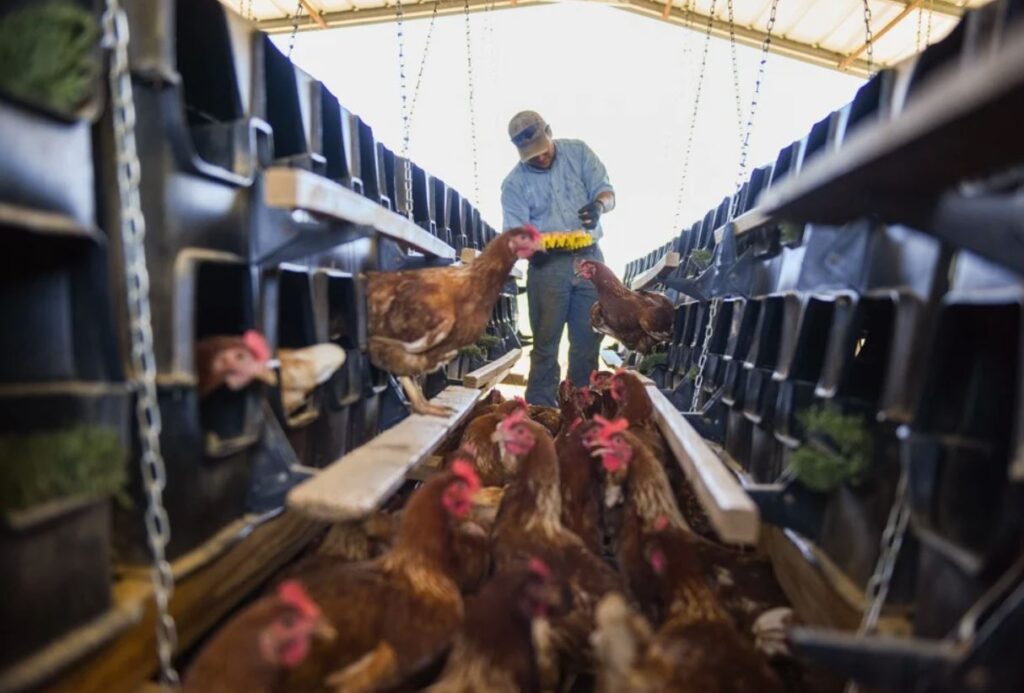
nnnn
Competency No. 3: Necropsy
nnnnThe post-mortem examination of layer and pullet carcasses is undeniably valuable for egg farms and should be an expected skill for employees at the supervisory level and above. This is as true for layers in conventional cages as for birds housed in alternative production systems. However, this knowledge on the part of the poultry farmer to be able to perform a basic necropsy on their layers takes on particular importance in cage-free systems, as birds are subject to a greater number of external variables.
nnn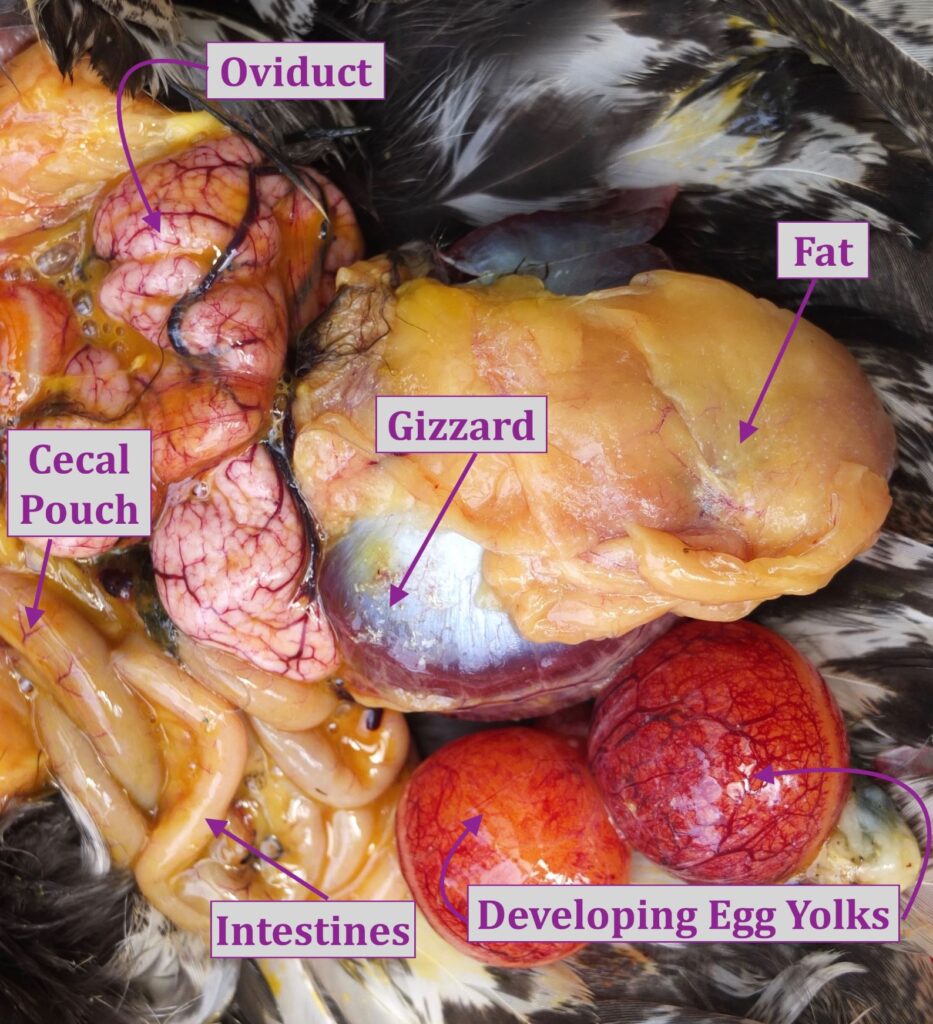
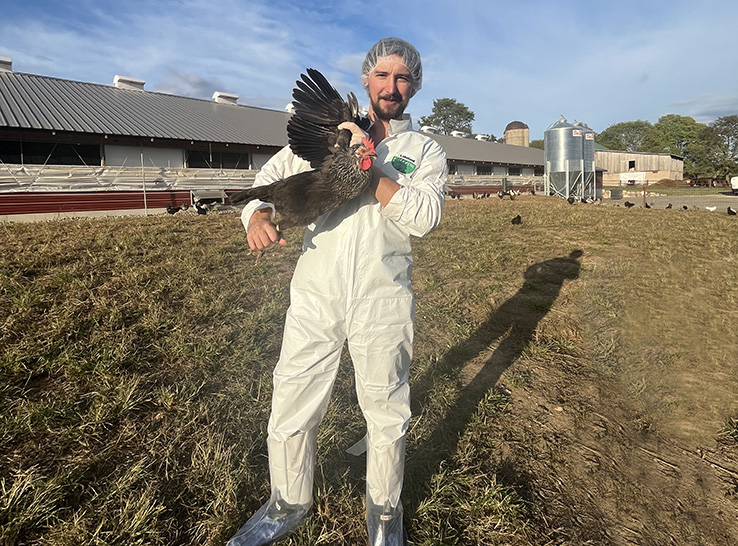
Although a complete macroscopic pathological diagnosis is not expected at this level of employment, the ability to select appropriate specimens, perform complete carcass breakdowns, and take relevant and representative photographs for internal dissemination is expected.
nnnnAgain, a standardised “beak to toe” approach should be used to ensure that the operator does not omit any relevant organ system. It is strongly recommended that supervisory employees spend one-on-one time with the flock veterinarian to learn the technique. Repetition is encouraged, and the “see one, do one, teach one” educational theory for learners can be applied until the employee develops a confident rhythm for post-mortem examinations.
nnnnThe four specimen selection categories cover normal cull birds, moribund birds, fresh mortality, and old mortality. A competent supervisor must be able to discern whether the objective of a necropsy session is for performance surveillance or morbidity and mortality investigation.
nnnn3.1 – Cull birds
nnnnCull birds should be selected at random and should have a normal and representative appearance for performance surveillance purposes. These hens can serve a greater purpose by providing the management team with vital information on intestinal condition, parasite burden, musculature, fat pad, and laying status.
nnnn3.2 – Moribund birds
nnnnMoribund birds should be easily identifiable through flock examination and are particularly valuable during the early identification of problems.
nnnn3.3 – Fresh mortality
nnnnThe fresher the mortality, the better. This is because laying hens, whose internal body temperatures are normally around 41ºC, can deteriorate rapidly after death due to a combination of internal heat, external conditions, and scavenging by the flock. The race against autolysis is especially important when seeking to obtain a true picture of the intestinal health of birds, as the macroscopic architecture of these tissues can quickly become obscured by decomposition.
nnnn3.4 – Old mortality
nnnnThese specimens should not be included in necropsy sessions because some significant lesions may have been compromised by decomposition. Ultimately, the presence of a significant number of old carcasses indicates a larger problem with incomplete daily mortality removal.
nnnn3.5 – Points to examine at necropsy:
nnnnOnce appropriate specimens have been identified and collected, the main reference points to be examined include those listed below:
nnnn- n
- Feather coverage nnnn
- Facial sinuses nnnn
- Oral cavity nnnn
- Trachea nnnn
- Crop nnnn
- Pectoral plate (Sternum) nnnn
- Heart nnnn
- Lungs nnnn
- Liver nnnn
- Spleen nnnn
- Coelom in its entirety nnnn
- Fat pad nnnn
- Internal digestive tract (proventriculus, gizzard, duodenum, jejunum, ileum, caeca) nnnn
- Reproductive tract nnnn
- Kidneys nnnn
- Bursa of Fabricius (for immature birds) nnnn
- Thymus (for immature birds) nnnn
- Vent nnnn
- Vent feathers nnnn
- Claws (toes and nails) n
Even without the advanced necropsy knowledge of the poultry veterinarian, a poultry farmer with minimal training enabling them to carry out preliminary macroscopic pathological diagnoses can gain very valuable time in diagnosis to share lesions in real time with the appropriate professionals.
nnnnA necropsy is an underutilised opportunity to shorten investigation response times and engage our co-workers, who, most of the time, want to have a deeper understanding of poultry anatomy and physiology. As a veterinarian, I welcome this desire and recognise that field education is also an integral part of my work.
nnnnnnnn
Final thoughts
nnnnIn conclusion, we cannot achieve sustained and efficient daily egg production over time without a competent workforce that masters management data in cage-free systems. Currently, there is a demonstrated need to strengthen the skill sets of poultry supervisors of cage-free systems, and poultry veterinarians must be utilized for this important on-farm training. At a minimum, teaching supervisors about data management for each flock, its correct interpretation, the daily flock review, and basic field necropsy is essential to successfully produce eggs in cage-free systems.
nnnn
Source:
-. Article written by Alexander W. Strauch, DVM. Poultry Veterinarian, technical director of Four Star Veterinary Service, LLC, Minton Veterinary Service Office, Chickasaw, Ohio, USA and published in Modern Poultry Media at https://modernpoultry.media/three-core-competency-expectations-for-the-cage-free-poultry-workforce/
Alexander W. Strauch, DVM, is the lead poultry veterinarian for the Ohio-based clinic of Four Star Veterinary Service. He serves multiple commercial poultry farms in the U.S. and consults with international clients. He is dedicated specifically to laying hen operations and has a special interest in cage-free production. He can be contacted at astrauch@4starvets.com and https://4starvets.com/veterinarian/alex-strauch-dvm/
nnnn
Do you want to stay one step ahead in poultry farming?
Subscribe for free to our eNewsletter and receive a weekly selection
of the best information to anticipate trends, stay up to date, and improve as a poultry industry professional.
NeXusAvicultura: Vision, Criteria, Quality and Context.