
A multi-year study by Wageningen Bioveterinary Research using two HVT-H5 vaccines under commercial conditions — 85 weeks of monitoring, more than 8,600 serological samples — dispels several reasonable doubts about vaccination against avian influenza: it works, it is safe, it does not compromise egg production, and it does not mask infection when accompanied by DIVA surveillance. The study was commissioned by the Dutch Ministry of Agriculture and funded by the Dutch poultry inter-branch organisation (AVINED).
From 96% to 10–30%: the figure that changes the debate
Netherlands, 15 May 2026 – The question that had been hovering over the European debate on vaccination against highly pathogenic avian influenza (HPAI) for more than four years —to what extent does vaccination actually reduce the risk of an outbreak under commercial farm conditions?— has just received a numerical answer. And it is compelling.
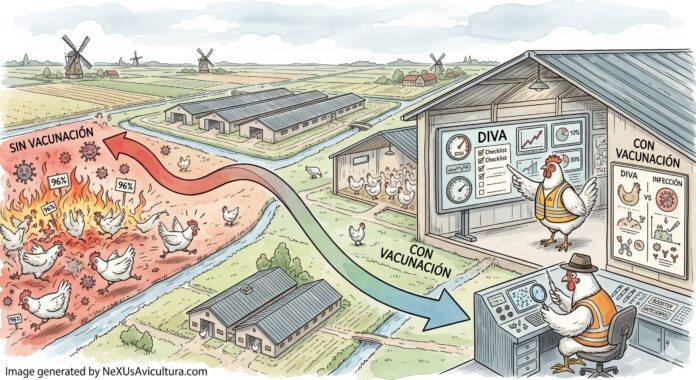
According to farm-level modelling developed by Wageningen Bioveterinary Research (WBVR), Wageningen University & Research (WUR), Royal GD and the Faculty of Veterinary Medicine at Utrecht University, the probability that introduction of the virus into a flock results in an outbreak falls from approximately 96% in unvaccinated birds to 10–30% in vaccinated birds. The exact figure depends on the vaccination strategy and, above all, on whether or not a booster dose is administered.
“Without vaccination, the probability of an outbreak following contact with the virus is 96%.
With vaccination, it falls to 10–30%.”
The average scale of an outbreak is also drastically reduced: from around 14 farms affected per episode in the unvaccinated scenario, to just 1 or 2 with vaccination. In other words, not only are individual outbreaks prevented; the epidemic cascade that turns a viral incursion into a sector-wide emergency is also dismantled.
85 weeks on farm: a study designed to reflect field reality
The study, commissioned by the Dutch Ministry of Agriculture, Fisheries, Food Security and Nature (LVVN) and co-funded with AVINED (the Dutch poultry inter-branch organisation), evaluated two commercial vaccines based on HVT vectors with an H5 insert: VAXXITEK HVT+IBD+H5 (Boehringer Ingelheim) and Vectormune® AI (Ceva). Both were administered at one day of age in two commercial laying hen farms in the Netherlands, with monthly serological monitoring over more than 85 weeks — that is, the complete production cycle.
The methodological novelty is not trivial. Until now, most of the evidence came from trials conducted under controlled conditions with limited groups of birds. This study combines — and this is what is truly useful for authorities and producers — field data from real farms with transmission trials at WBVR’s high-biosecurity facilities, where subgroups of birds were experimentally exposed to H5N1 virus (clade 2.3.4.4b) at different points in the production cycle.
“An unvaccinated adult laying hen
can on average infect more than six flock-mates.
In vaccinated birds, transmission is significantly slowed.”
The decisive factor: high, stable antibody levels and the role of the booster
The most practically relevant zootechnical and immunological conclusion of the study is not “whether to vaccinate or not”, but how to vaccinate. Flocks that received only the primary vaccination dose showed rising antibody levels during rearing and high levels during production, but with fluctuations throughout the cycle. Flocks that also received a booster dose maintained high and uniform antibody levels throughout the entire laying period.
This point is critical: the magnitude of the transmission reduction observed in challenge trials was closely correlated with antibody levels in the flock. The higher the mean titre and the greater the uniformity, the slower the rate of spread. As lead researcher Kim Bouwman summarises: what matters is not only vaccinating, but achieving and maintaining sufficiently high and homogeneous antibody levels throughout the entire flock.
“THE BOOSTER DOSE IS ESSENTIAL.
With a booster, antibody levels remain high and uniform throughout the entire production cycle.”
“Without a booster, antibody levels fluctuate. With a booster, they remain high and uniform throughout the entire production cycle.”
| What is a “booster”? | Why it is specifically important in the Wageningen study |
| In vaccinology, a booster or booster dose is a dose administered after primary vaccination to reactivate and amplify the immunological memory generated by that first dose. It is not a repeat of the vaccine from scratch: it stimulates an already primed immune system to produce a higher and, above all, longer-lasting antibody peak. | HVT-H5 vaccines (VAXXITEK and Vectormune AI) administered at day 1 of life are live vectors: they induce very good cellular immunity and a progressive humoral response, but circulating antibody titres may not reach the level — or, above all, the flock-level uniformity — needed to halt H5N1 transmission. The study demonstrates precisely this: with the primary schedule alone, antibody levels rise but fluctuate; with a subsequent booster dose (typically an inactivated H5 vaccine administered before peak lay), antibody levels remain high and homogeneous throughout the entire cycle. And since the rate of transmission is directly correlated with the mean flock titre, it is that stability which drives the outbreak risk down from 30% to 10%. |
Safety confirmed: zero impact on mortality and egg production
Another recurring argument against mass vaccination — the alleged productive cost — is also refuted by the data. No visible adverse effects were observed, flock health remained stable and mortality stayed within normal ranges for commercial production. Egg production reached the expected normal levels, including peak lay. In short, neither productive penalties nor welfare concerns.

DIVA works: vaccination does not mask infection when properly implemented
This was probably the most serious technical bottleneck for commercial deployment: the fear — and the recurring commercial objection from export markets — that vaccination would mask viral circulation and block exports. The study provides robust evidence to the contrary.
| Note: DIVA: Differentiating Infected from Vaccinated Animals This acronym stands for Differentiating Infected from Vaccinated Animals. It is commonly referred to as the DIVA strategy or DIVA system, and the acronym is retained in all languages. |
Of more than 8,600 serological tests carried out on vaccinated farms, 99.8% returned negative results for infection, indicating the absence of viral circulation. These results were further confirmed by negative PCR on samples from dead birds. Regarding the sensitivity of the system, epidemiological simulations show that, with an adequate surveillance programme, more than 93% of outbreaks in vaccinated flocks can be detected in time. The conclusion is clear: vaccination and surveillance are not alternatives; they are obligatory complements.
“8,600 tests, 99.8% negative.
THIS STUDY SHATTERS THE MYTH.
Vaccination does not mask infection when appropriate diagnostic testing is applied.”
Food safety: minimal risk
The research team also analysed eggshell samples and tissues. Only isolated PCR-positive results were detected, with no isolation of infectious virus. The implication for the industry and consumers: the food safety risk associated with products from vaccinated flocks is minimal. This is a relevant finding in view of the inevitable public debate that will accompany the roll-out of any vaccination programme.
STUDY SUMMARY SHEET
| Institutions | Wageningen Bioveterinary Research (WBVR) · Wageningen University & Research (WUR) · Royal GD · Faculty of Veterinary Medicine, Utrecht University |
| Funding | Dutch Ministry LVVN + AVINED (poultry inter-branch organisation) |
| Vaccines evaluated | VAXXITEK HVT+IBD+H5 (Boehringer Ingelheim) and Vectormune® AI (Ceva) |
| Challenge virus type | H5N1, clade 2.3.4.4b |
| Design | Vaccination at day 1 ± booster · follow-up >85 weeks on commercial farms + transmission trials under biosecurity conditions |
| Serological sampling | Monthly throughout the entire cycle · >8,600 tests |
| Outbreak risk (unvaccinated) | ≈ 96% |
| Outbreak risk (vaccinated) | 10 – 30% (depending on schedule and booster) |
| Mean outbreak scale | Falls from ≈14 farms to 1–2 farms affected |
| DIVA surveillance sensitivity | >93% of outbreaks detectable |
| Serological outcome | 99.8% negative · no evidence of masking |
| Impact on production and welfare | No adverse effects · normal production and mortality |
| Next step | The Netherlands is moving towards mandatory vaccination of laying hens |
“The question is not
vaccinate or surveil,
it is
vaccinate and surveil”
The Netherlands moves towards mandatory vaccination
On the basis of these results — and of the parallel trials currently under way in other Member States — the LVVN Ministry has already confirmed that it will take formal steps towards introducing avian influenza vaccination within the regular poultry vaccination programme, with the aim of making it mandatory for laying hens. This would be the first national mandatory programme of this scope in the EU following the European regulatory approval granted in 2023 and the pioneering French experience of mandatory vaccination in ducks.
nnnnThe context reinforces the urgency. During 2025, global health authorities had to cull an average of 4.3 million birds per month due to AI, adding to a cumulative figure exceeding 633 million birds lost since 2005, according to data compiled by OMSA/WAHIS. In this scenario, no serious poultry economy can continue to rule out vaccination as a tool by default, especially when there are now numbers to back it up.
nnnn
The question is no longer whether to vaccinate or not, but when, the surveillance, and the schedule.
nnnnThree practical conclusions for technical directors, poultry veterinarians, and national animal health authorities:
First: the debate is no longer “vaccinate or not”, but “with what protocol, with what surveillance, and with what schedule“.
Second: the “booster dose” moves from an option to a top-tier clinical and economic recommendation, given its differential performance on transmission control.
And third: any national programme will require parallel investment in active DIVA serological surveillance, without which the epidemiological effectiveness of the vaccine is neutralised by the loss of visibility.
nnnnn“Correct and ongoing monitoring is essential when implementing the vaccination programme”
n
nnnn
Sources:
Report «Vaccination of poultry with HVT-based H5 vaccine against highly pathogenic avian influenza (HPAI) H5N1 virus (clade 2.3.4.4b)».
Wageningen Bioveterinary Research / Wageningen University & Research
Faculty of Veterinary Medicine, Utrecht University. Dutch Ministry of Agriculture, Fisheries, Food Security and Nature (LVVN). Technical datasheets: VAXXITEK HVT+IBD+H5 (Boehringer Ingelheim) and Vectormune® AI (Ceva).
To learn more:
-. Vaccination in poultry against avian influenza
-. Vaccination of workers on poultry farms at NeXusAvicultura.com
-. Avian Influenza vaccine shows promising results in laying hens
-. AI vaccination does not have to be an all-or-nothing strategy
nnnn
Do you want to stay one step ahead in poultry?
Subscribe for free to our eNewsletter and receive a weekly selection
of the best information to anticipate trends, stay up to date, and grow as a poultry professional.
NeXusAvicultura: Vision, Insight, Quality and Context.