
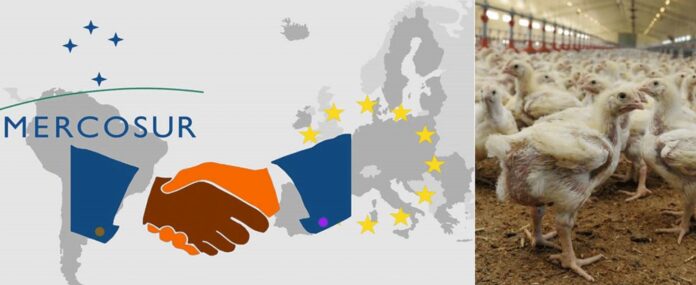
A qualified majority of member states approved the EU-MERCOSUR agreement in the EU Council today, 9 January 2026, paving the way for its signing next week.
nnnnThis decision will have direct consequences for the European beef, poultry, and cereal sectors, as well as for consumers.
nnnnFor the agricultural sectors, this choice is unacceptable. The EU is abandoning the construction of a trade policy consistent with the requirements imposed on its own producers, by deciding to formalise the signing despite strong opposition from the sectors and from public opinion. This abandonment weakens food sovereignty and food security for consumers.
nnnnIn this power struggle within the EU itself, France also bears its share of responsibility, despite its negative vote today in the EU Council. When it still had decisive legal and political tools at its disposal to prevent this outcome, it chose not to use them fully. Its veto, which should have been mobilised at the right moment, when unanimity still applied, was never activated. A further sign that France did not do everything it could to genuinely block this agreement is that it could have taken the matter to the Court of Justice of the EU to challenge the legal basis of the agreement — and once again, this tool was not deployed. Under these circumstances, its rejection expressed today changes nothing: it could no longer have any effect.
nnnnnnnnThe French agricultural sectors — INTERBEV (the livestock and meat interprofessional organisation), ANVOL (the poultry meat interprofessional organisation) and INTERCEREALES (the French cereal sector interprofessional organisation) — are now calling on Members of the European Parliament to make their voices heard, by broadly rejecting ratification of the agreement and by referring the matter to the Court of Justice of the EU regarding the legality of the “split” procedure decided by the European Commission. This vote is indispensable for European democratic debate, particularly when this agreement is so widely contested.
The “safeguard clause“: a false protection, pure window-dressing
nnnnPresented as a response to agricultural concerns, the safeguard clause in the EU-MERCOSUR agreement does not constitute a protective tool. Its activation would not halt imports, but would instead open a lengthy and strictly reactive investigation, once imbalances are already entrenched. The thresholds set, the absence of automaticity, and the removal of any legal reciprocity leave the European Commission with a wide margin of discretion. In practice, the mechanism is difficult to activate and limited in duration. The European response relies primarily on ex-post budgetary mechanisms, with no effect on trade flows. Without legally binding mirror measures, this clause is, above all, a matter of political optics.
Source:
-. ANVOL France
Further reading:
-. EU-MERCOSUR Agreement
nnnn
Want to stay one step ahead in poultry?
Subscribe free to our eNewsletter and receive a weekly selection
of the best information to anticipate trends, stay up to date, and grow as a poultry industry professional.
NeXusAvicultura: Vision, Criteria, Quality and Context.