
AVIAN HEALTH | ANALYSIS | 19 MAY 2026
The MAPA report of 12 May 2026 confirms 269 commercial outbreaks and more than 15.4 million birds affected in Europe since 2022. Three genetically independent introductions of genotype VII, persistence in vaccinated flocks, and an unexpected shift in the clinical pattern are redefining the continent’s animal health landscape.
The official picture: 269 outbreaks and 15.4 million birds affected since 2022
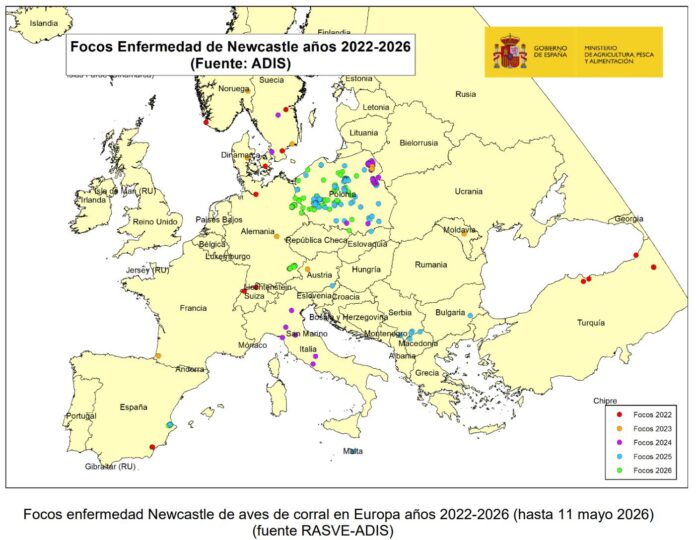
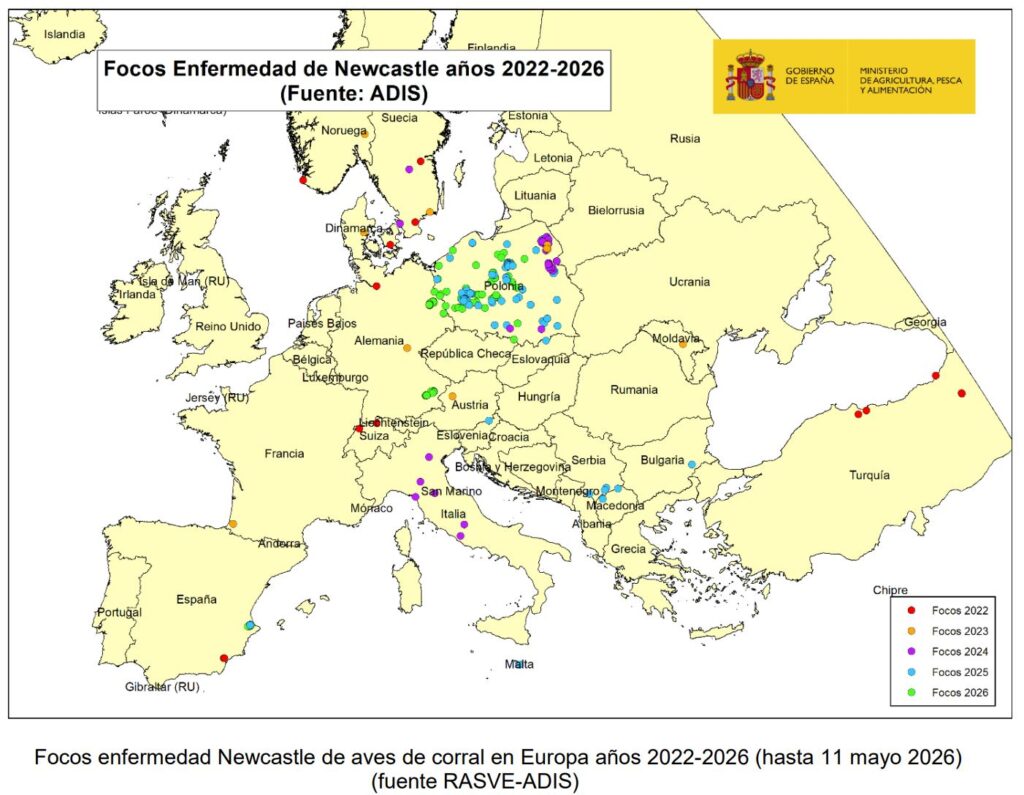
The report of the Ministry of Agriculture, Fisheries and Food (MAPA) published on 12 May 2026 provides the most detailed account to date of Newcastle disease circulation in Europe. Between 2022 and 11 May 2026, the European Union’s official notification systems (ADIS) recorded 269 commercial outbreaks and 15,461,390 birds affected. The year 2025 alone accounts for 100 outbreaks and 8.58 million birds; in 2026 so far, 105 outbreaks and 3.65 million birds have already been reported, confirming that the curve is not flattening.
The scale of the increase becomes clear when compared against recent historical baselines: 16 outbreaks in 2022, 11 in 2023, 37 in 2024, and 100 in 2025. In less than two years, Europe has moved from a residual situation to sustained circulation, with two countries — Poland and Germany — as the quantitative drivers and a third — Spain — as an epidemiologically independent introduction. To understand why this report matters, each of those vectors deserves separate examination.
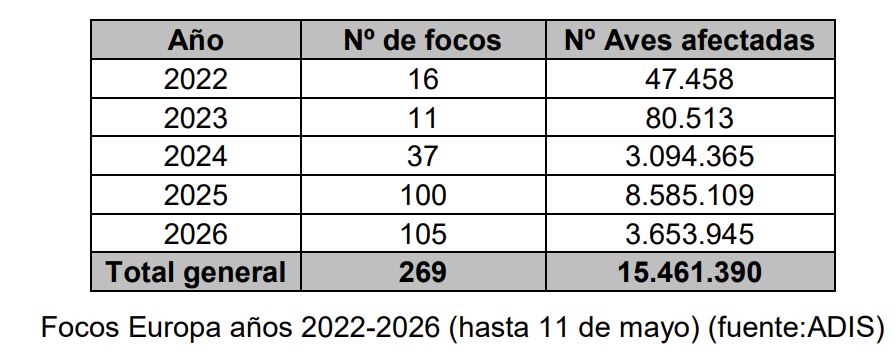
| Europe has accumulated 269 commercial outbreaks and more than 15.4 million birds affected since 2022. The years 2025 and 2026 to date already account for 76% of the total: the resurgence is structural, not seasonal. |
Poland: two independent genomic introductions and mandatory vaccination with no clear epidemiological outcome
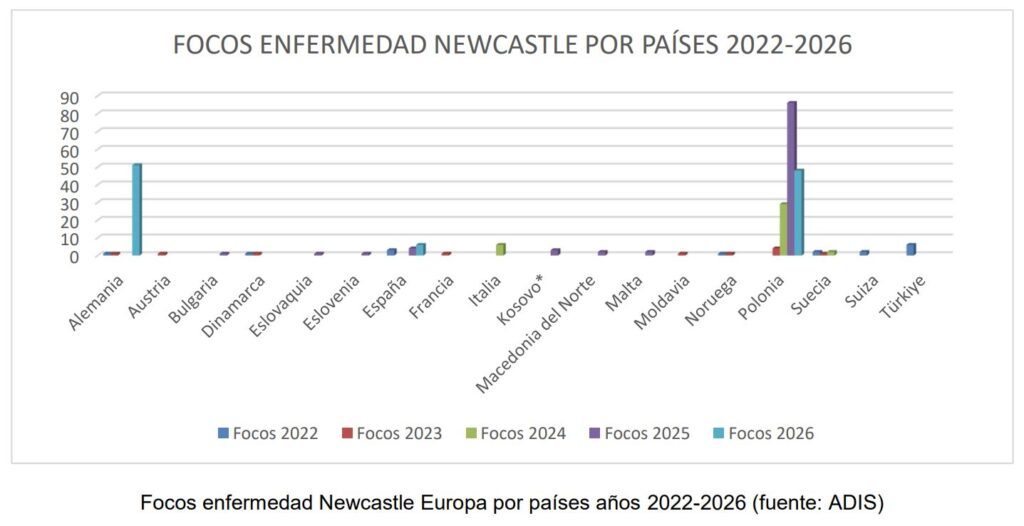
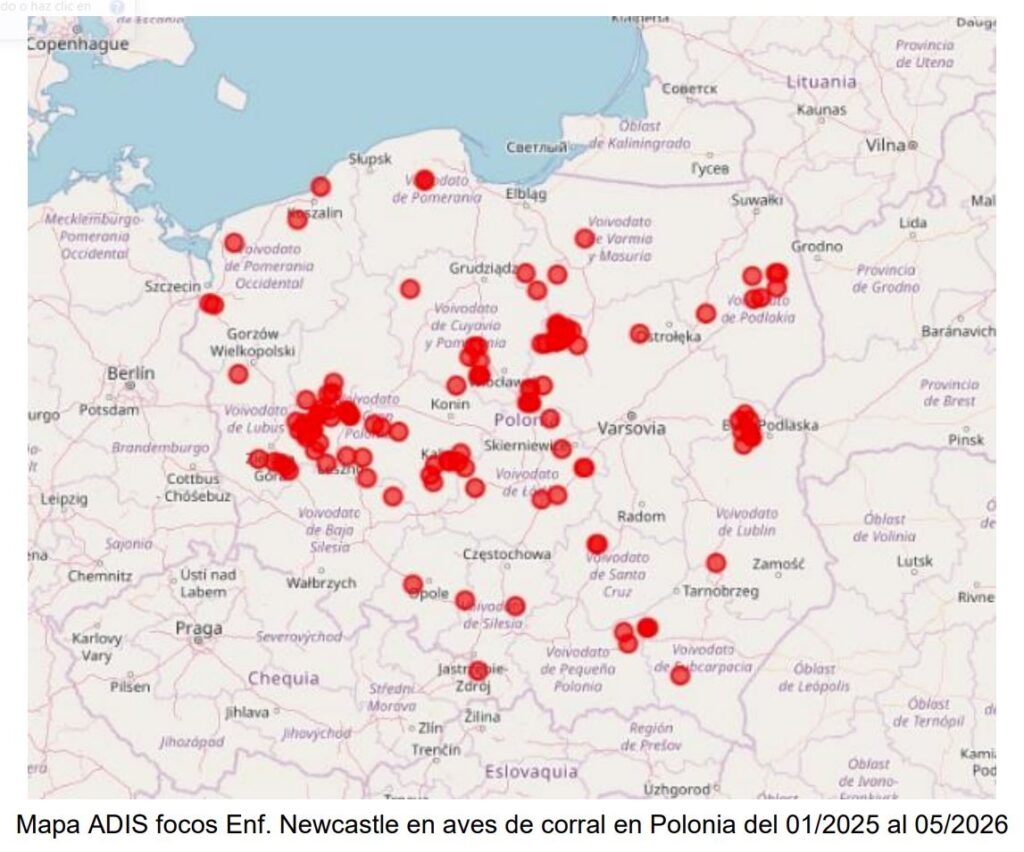
Poland continues to set the pace of the disease in Europe. Following the reappearance in 2023 (four outbreaks), the curve surged to 29 outbreaks in 2024, 86 in 2025, and 48 new commercial outbreaks up to 11 May 2026. The most sensitive finding in the MAPA report is that the majority of the 2026 outbreaks occurred in previously vaccinated flocks, despite the mandatory vaccination requirement introduced by the Polish Ministry of Agriculture in April 2025.
The most novel contribution of the report is the genomic identification of two independent virus introductions into Polish territory: the first in July 2023 and the second in September 2024. Both belong to genotype VII.1.1 — highly virulent, neurotropic and velogenic — and both are genetically closer to the Russian 2022 strain than to any other currently circulating in the EU. In other words, this is not a radial spread from a single initial focus, but rather separate entries of the same viral lineage through a porous eastern border.
The response from Brussels came in the form of Commission Implementing Decision (EU) 2026/816 of 1 April, which amends the annex to Implementing Decision (EU) 2025/2256 and extends the emergency measures while updating the restricted zones. The number of outbreaks in non-commercial captive birds in Poland further underscores the pressure: 95 outbreaks in 2025 and a further 54 in 2026 to date.
| Two independent genomic introductions in Poland (July 2023 and September 2024), both of genotype VII.1.1 and genetically close to the Russian 2022 strain: the virus is entering through the eastern border, not spreading from a single focus. |
Germany: from zero to 51 outbreaks in less than three months
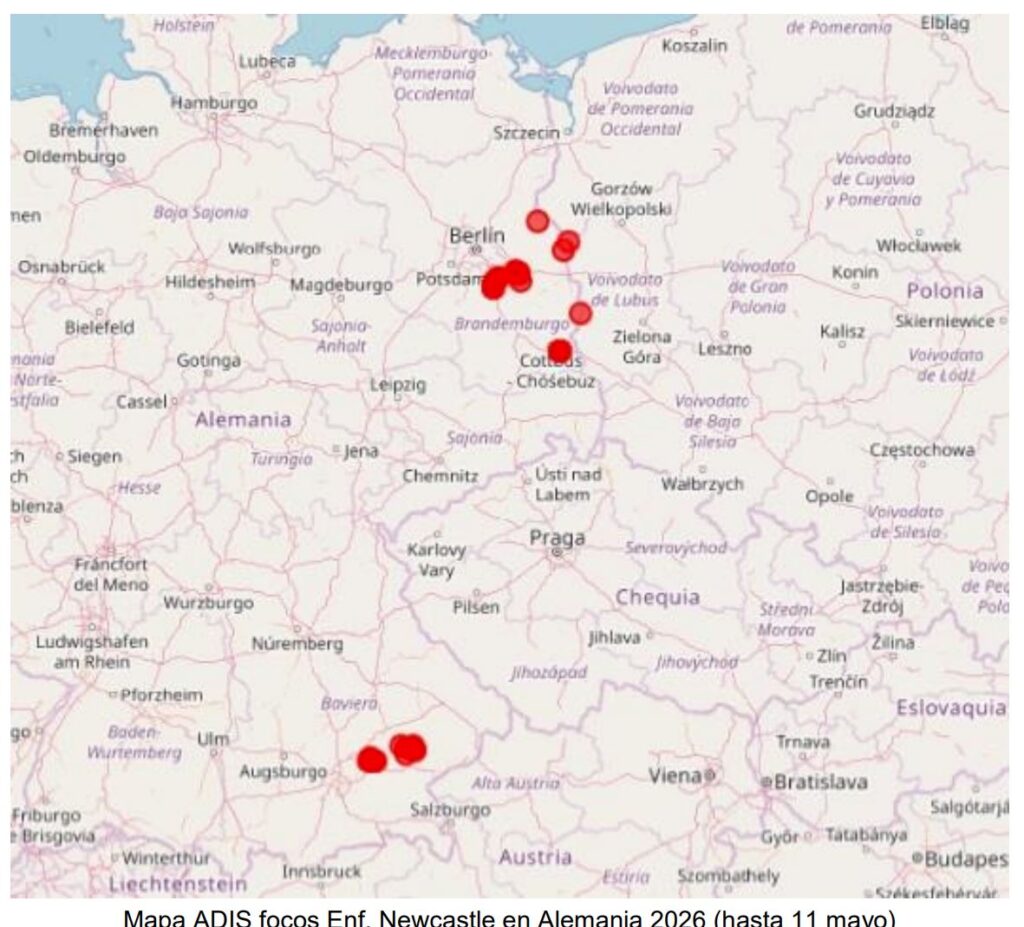
The Friedrich-Loeffler-Institut confirmed on 20 February 2026 the first German outbreak in a commercial establishment housing 18,000 turkeys in the Oder-Spree district (Brandenburg). Five days later, a second outbreak was confirmed in Bavaria. By 11 May, the total had risen to 51 outbreaks across German territory: 37 in Brandenburg and 14 in Bavaria. Sequencing points to the same genotype VII.1.1 circulating in Poland, closing the cross-border epidemiological loop.
The qualitative finding mirrors that observed in Poland: many of the affected establishments were vaccinated, which prompted the German Standing Committee on Veterinary Vaccination (StIKo Vet) to recommend that producers review their immunisation schedules and, where in doubt, administer booster doses. The vaccines authorised in the EU are based on genotypes I and II and, according to StIKo Vet, retain efficacy against VII.1.1; however, the attenuated clinical picture in vaccinated birds hampers early diagnosis and facilitates silent transmission.
| Germany went from 0 to 51 outbreaks in less than three months. Brandenburg accounts for 37 outbreaks and Bavaria for 14, all linked to the same VII.1.1 lineage circulating in Poland. Eighteen years of disease-free status, gone. |
Spain: 10 outbreaks, one comarca, and — crucially — a distinct genotype VII lineage
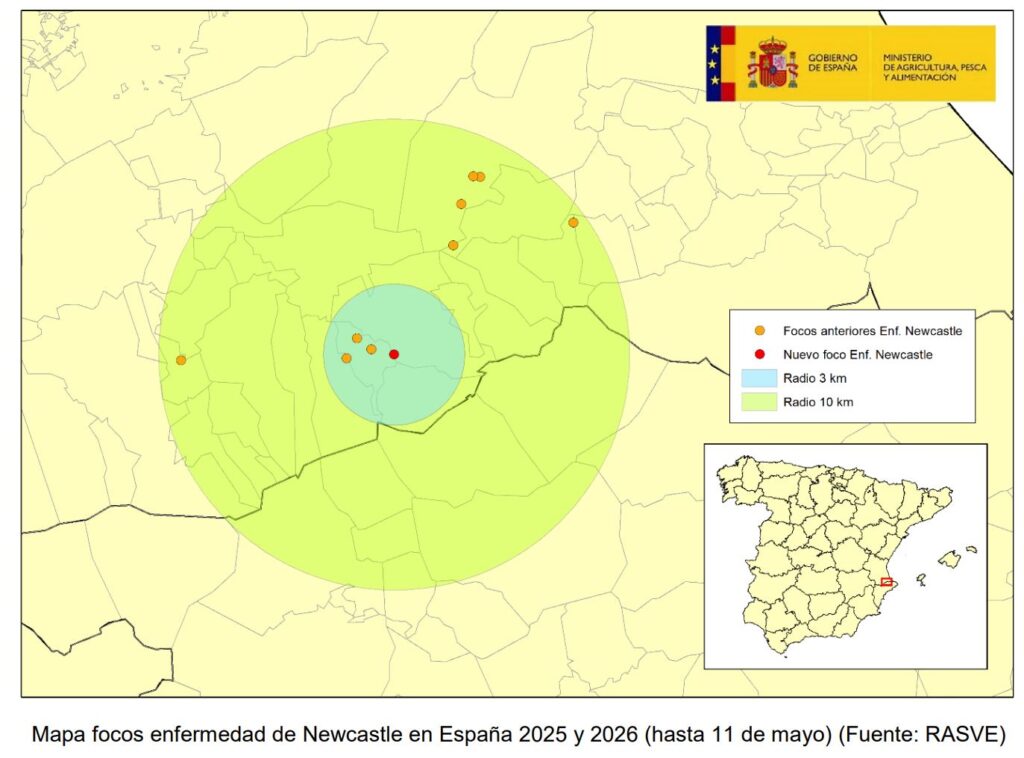
Spain has recorded 10 confirmed outbreaks in poultry up to 11 May 2026, all in the comarca of Vall d’Albaida (Valencia). The first occurred on 29 December 2025 in Llutxent (broilers, 15,000 birds); three secondary outbreaks followed on 2 January (28,500, 16,500 and 20,100 birds); the fifth on 20 January in a flock of 75,000 broilers; the sixth on 9 March in Terrateig (layers, 27,000 birds); the seventh on 9 April in Ráfol de Salem (broilers, 26,300); the eighth the following day in an adjacent laying hen unit (32,000 birds); the ninth on 28 April, also in Ráfol de Salem (broilers, 38,900 birds); and the tenth on 8 May in Castelló de Rugat (20,040 laying hens vaccinated with three doses). Of the ten outbreaks, five occurred in vaccinated flocks.
The key contribution of the MAPA report is genetic. Phylogenetic analysis conducted by the Central Veterinary Laboratory of Algete has determined that the virus circulating in Spain belongs to genotype VII, but to a lineage distinct from the one circulating in Poland and Germany (VII.1.1). In epidemiological terms, this represents a third independent introduction of genotype VII into the EU territory, unrelated to the Polish-German axis. The hypothesis regarding the source remains open, but wild bird populations are gaining ground as a potential origin over intra-EU commercial movements.
The most recent outbreak warrants particular attention. The farm in Castelló de Rugat recorded no mortality whatsoever, and suspicion arose solely from a 7% drop in egg production over one month. The sixth outbreak, in Terrateig, showed a similar pattern: five vaccinated houses, with only the youngest flock (23 weeks) testing positive. The seventh, in Ráfol de Salem, involved 35-day-old broilers, also vaccinated. The Comunitat Valenciana introduced mandatory vaccination in February 2026, but the attenuated clinical picture in immunised flocks confirms what Germany’s StIKo Vet had already warned: vaccination reduces viral shedding and mortality, but does not prevent infection and makes early detection more difficult.
| The virus in Spain belongs to genotype VII but to a genetically distinct lineage from that circulating in Poland and Germany: a third independent introduction into EU territory, unrelated to the Polish-German axis. |
Slovenia, North Macedonia, Malta, Bulgaria and Slovakia: isolated outbreaks, a common denominator
Beyond the main axis, the report documents sporadic outbreaks notified in 2025: Slovenia (1, February), North Macedonia (2, March and June), Malta (2, May), Bulgaria (1, July) and Slovakia (1, December). All occurred in small- to medium-sized establishments and, with the exception of Malta (25,640 birds), involved flocks of fewer than 2,100 birds. None of these countries has reported new outbreaks in 2026, suggesting effective containment following regulatory measures. The common denominator, however, is nonetheless noteworthy: in all cases the pattern is one of isolated events with no secondary spread — a notable difference compared with Poland, Germany and Spain.
Sweden: the last “vaccination-free” bastion in the Baltic falls
The quietest finding in the report is also one of the most symbolic. Sweden began preventive vaccination against Newcastle disease in April 2026, thereby losing its historic status as a vaccination-free country and leaving Finland as the only EU Member State still holding that designation. The decision follows a sequence of sporadic detections beginning in 2021 — Fjugesta (Örebro), Johannishus, Helsingborg (more than 230,000 birds in 2024), Ödeshög (18,000 laying hens) — which made passive surveillance without immunological backing untenable.
Sweden’s move is not a minor technical adjustment. It means that the differentiated health requirements previously guaranteed by vaccination-free status for intra-EU trade no longer apply, aligning Sweden with the majority of the EU and altering the regional commercial balance.
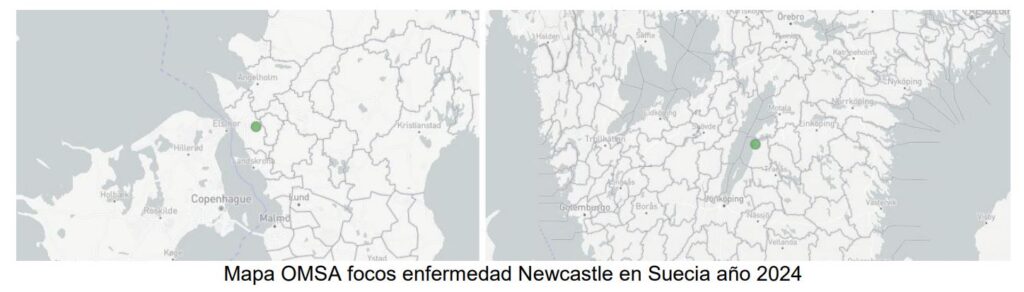
| After two decades as Europe’s benchmark for vaccination-free status, Sweden capitulates in April 2026 and begins preventive immunisation. Finland is now the only EU country still holding that designation. |
Captive birds: the overlooked epidemiological front
nnnnWhile media attention focuses on commercial holdings, the MAPA report recalls that a second front exists, equally active. Since the beginning of 2025, the ADIS systems have recorded 225 outbreaks in non-commercial captive birds in the EU: 121 in 2025 and 103 so far in 2026. Poland (95 + 54) and the Czech Republic (17 + 32) account for the majority, with a presence also in Germany (1 + 14), Slovakia, Slovenia, Latvia, Lithuania and the Netherlands. This figure is significant because non-commercial holdings act as an epidemiological reservoir capable of sustaining viral circulation between commercial outbreaks.
nnn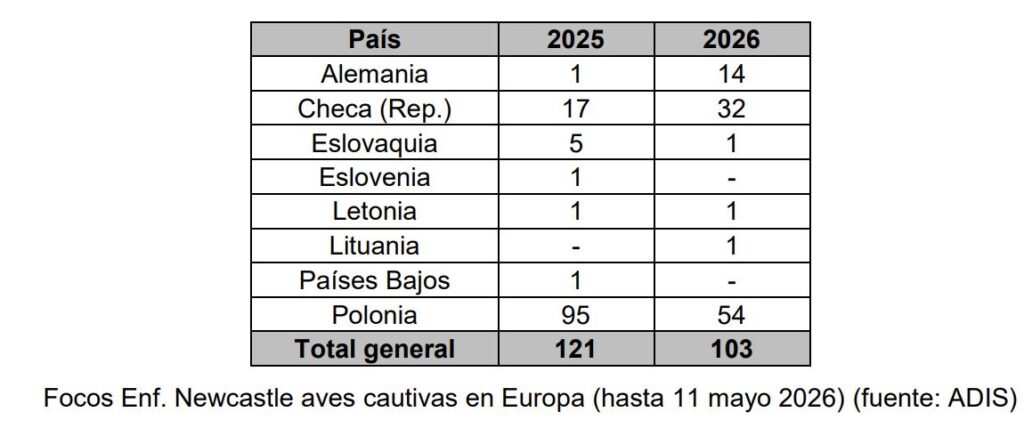
Sector analysis: what the report puts on the table
nnnnThree operational conclusions can be drawn from the document.
First: vaccination, whether voluntary or compulsory, is not an absolute guarantee and must be strictly combined with biosecurity and passive surveillance
Second: the attenuated clinical pattern in vaccinated flocks is changing suspicion thresholds. Drops in egg production of 7% without mortality, trickle mortality, or slight decreases in feed or water consumption are now sufficient signals to activate the protocol, as recommended by MAPA in its technical note of 12 May. A cultural shift on farms and within official veterinary services that is far from trivial.
nnnnThird: genotype VII has consolidated itself as the dominant lineage in Europe, with three genetically independent introductions (Poland/Germany, Spain and, episodically, other Member States). The technical document from the British Defra published on 30 March 2026, which raises the risk of introduction into Great Britain from low to medium, confirms that the reading is not solely continental: the dimension is already transnational and is driving a coordinated review of vaccination and biosecurity strategies.
nnn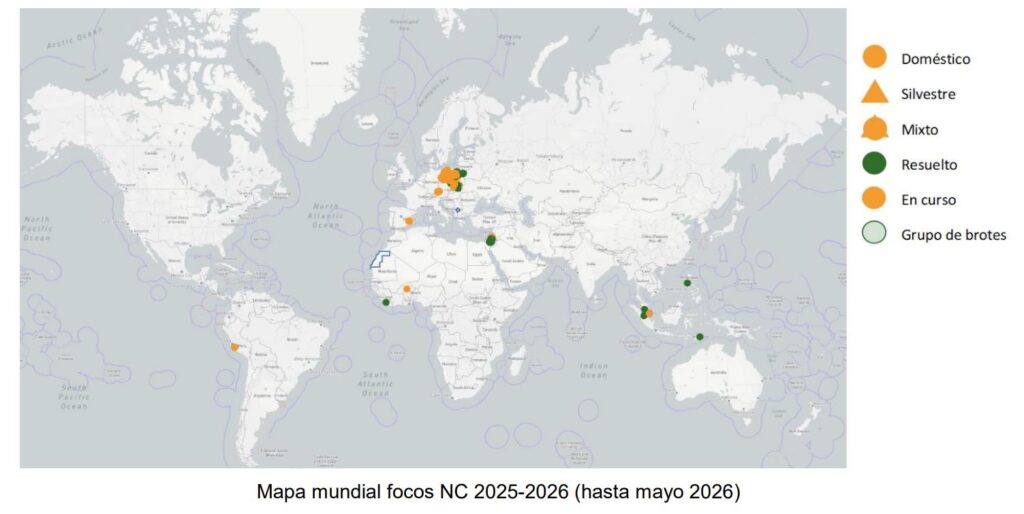
Summary sheet
nnnn| Main source | MAPA report «Update on the epidemiological situation of Newcastle disease», 12 May 2026 |
| Commercial outbreaks in Europe (2022–2026) | 269 outbreaks · 15,461,390 birds affected (source: ADIS) |
| Commercial outbreaks in 2026 (EU) | 105 outbreaks · 3,653,945 birds affected (up to 11 May) |
| Spain | 10 outbreaks in poultry · all in the Vall d’Albaida district (Valencia) · 5 in vaccinated flocks · genotype VII (independent introduction) |
| Poland | 48 commercial outbreaks in 2026 · 54 outbreaks in captive birds · compulsory vaccination since April 2025 |
| Germany | 51 commercial outbreaks since 20 February · Brandenburg (37) and Bavaria (14) · genotype VII.1.1 |
| Sweden | Disease-free status without vaccination lost in April 2026 · preventive vaccination commenced |
| Captive birds in the EU | 121 outbreaks in 2025 + 103 in 2026 (Poland: 95+54; Czech Rep.: 17+32) |
| EU regulatory framework | Implementing Decision (EU) 2026/816, of 1 April · Regulation (EU) 2016/429 · Delegated Reg. (EU) 2020/687 |
| Vaccines authorised in the EU | Genotypes I and II (inactivated and attenuated). Circulating virus: genotype VII |
nnnn
Timeline of Newcastle outbreaks in Spain:
nnnnAfter more than three years (since 2022) without any Newcastle case in Spain, the situation has become complicated in the Comunitat Valenciana since the resurgence of this disease in December 2025. The following is the list of outbreaks updated as of 11 May 2026:
nnnn- n
- The origin (Outbreak 1): The disease re-emerged in Spain in late December 2025 in the municipality of Llutxent (Valencia), in a farm of 15,000 chickens, breaking the disease-free country status that Spain had maintained since 2022. nnnn
- The spread (Outbreaks 2, 3 and 4): On 2 January 2026, three new secondary outbreaks were confirmed in the same municipality, affecting farms with flock sizes of 28,500, 16,500 and 20,100 birds. The investigation pointed to geographical proximity and links between owners as transmission factors. nnnn
- The fifth case (20 January 2026) in a farm of 75,000 broilers. nnnn
- Sixth outbreak (9 March 2026) in Terrateig, affecting a single shed of 27,000 hens in a poultry complex. nnnn
- Seventh outbreak (9 April 2026) at a farm of 26,300 broilers and eighth outbreak (10 April 2026) at a farm of 32,000 laying hens. Both in Ráfol de Salem. nnnn
- Ninth outbreak (28 April 2026) at a farm of 38,900 broilers in Ráfol de Salem. nnnn
- Tenth outbreak (8 May 2026) at a farm of 20,040 laying hens in Castelló de Rugat (official communiqué). n
nnnn
To find out more:
-. MAPA report of 12 May 2026 on the current Epidemiological Situation of Newcastle Disease
-. What is Newcastle Disease?
-. National Newcastle Surveillance Programme 2026. (14-page PDF from MAPA published in May 2025)
-. Main page on Newcastle Disease Control from MAPA
-. Newcastle Disease on NeXusAvicultura
nnnn
Do you want to stay one step ahead in poultry farming?
Subscribe free to our eNewsletter and receive a weekly selection
of the best information to anticipate trends, stay up to date and develop as a poultry industry professional.
NeXusAvicultura: Vision, Criteria, Quality and Context.